
Yippee-Ki-Yay, Fascia!
What Die Hard Teaches Us About Elastic Recoil & Resilience Under Pressure
You don’t usually think of John McClane as a fascia educator.
He’s a cop in the wrong place at the wrong time… crawling through vents, leaping off rooftops, surviving explosions, and improvising under extreme stress.
But beneath the action-movie chaos is the most overlooked lesson in human performance:
The body doesn’t survive pressure because of the muscle.
It survives because of fascia.
And Die Hard might be the most accurate fascia metaphor Hollywood ever created.
Today, we’re breaking down why, through science, storytelling, and the Fascia Training Institute lens.

When the Pressure Hits, Muscles Fail. Fascia Adapts.
No matter how strong someone is, muscles fatigue quickly under threat. They burn glucose, tighten, tremble, and lose efficiency.
But fascia, your body’s three-dimensional connective tissue network, behaves differently.
Fascia is built for chaos.
It stores energy, absorbs impact, distributes force, and rebounds without conscious effort.
Muscles ask permission.
Fascia just responds.
This is why elite athletes, dancers, martial artists, and yes—even fictional action heroes—move through extremes with grace instead of tension.
Under pressure:
- Muscles stiffen
- Fascia elasticizes
- Muscles fatigue
- Fascia returns energy
- Muscles strain
- Fascia adapts in real time
In fascia science, we call this biotensegrity—the way the body stabilizes through tensional balance rather than brute force.
It’s the reason McClane survives Nakatomi Plaza.
And it’s the same mechanism behind fluid, injury-free movement in real life.
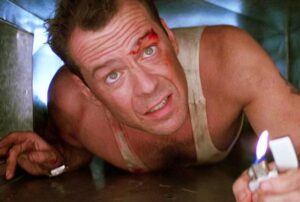
The Vent-Crawl Lesson: Elastic Loading + Fascial Glide
One of the most famous scenes in the movie is John crawling through a metal ventilation shaft with nothing but a lighter.
He isn’t “muscling” through it.
He’s gliding.
He’s shifting weight subtly.
He’s using body tension the way fascia wants it used:
light, elastic, efficient.
What’s happening in real anatomical terms?
✔ Elastic loading in the superficial back line
✔ Controlled recoil through the lateral line
✔ Glide between fascial layers so he doesn’t get stuck or strained
✔ Shock absorption with every micro-shift
Without fascial glide, you don’t make it through a vent.
You get stuck.
You brace.
You fatigue.
Your tissues densify.
Your brain interprets threat and tightens everything further.
Sound familiar?
That’s why so many clients feel “tight” even when they’re stretching constantly.
Tightness isn’t a muscle problem.
It’s a fascia problem.
And the fix isn’t force.
It’s rehydration, glide, and elastic loading.
(Exactly what we teach inside the Fascia Release Dynamic Stretching course.)

The Rooftop Jump: Shock Absorption & Elastic Recoil
John’s rooftop leap—fire behind him, hose around his waist—is the ultimate fascia moment.
No human survives that by “bracing.”
Bracing increases impact.
Impact causes tears.
The body survives by using:
✔ Fascial recoil
✔ Tensile loading
✔ Energy storage + return
✔ Force distribution across multiple lines
This is the same mechanism parkour athletes use to land from heights without injury.
It is also how:
- runners stay efficient
- dancers land quietly
- martial artists absorb kicks
- reindeer (and Santa 😉) move with no impact noise
Elastic fascia = silent, effortless shock absorption.
Rigid fascia = injury.
This is why training fascia is infinitely more protective than strengthening muscles.
Why Stress Makes You Tight: The McClane Nervous System Effect
McClane is constantly under threat, yet in moments of calm, he moves fluidly.
This mirrors real neurofascial behavior:
Fight-or-flight stiffens fascia.
Freeze locks it.
Regulation restores glide, hydration, and elasticity.
Your fascia mirrors your nervous system state.
This is why so many people:
- stretch but stay tight
- roll but stay stiff
- strengthen but still feel unstable
- “rest” but never recover
They are trying to fix fascia with muscle-based solutions.
But fascia follows the nervous system.
To change the body, you must regulate the brain.
(You can dive deeper into this in How to Beat Brain Burps and the free NeuroFascial Release™ Ebook.)

What Die Hard Teaches Us About Real-Life Performance
Here’s the truth:
You don’t need to survive an action movie to need better fascia.
You need it for:
- lifting groceries
- sitting at a desk
- walking up stairs
- running with your kids
- preventing injuries
- moving without pain
- avoiding burnout
Elastic fascia = resilient movement.
Stiff fascia = breakdown.
Every practitioner, athlete, and everyday human needs to understand this.

How to Train Your Inner Action Hero (Without the Broken Glass)
Here’s the good news:
Fascia responds FAST.
Faster than muscle.
Faster than you expect.
You can train it with:
✔ light, consistent load
✔ slow, oscillatory movement
✔ hydration
✔ nervous system regulation
✔ decompression techniques
✔ multi-directional elasticity training
3 resources to begin:
Learn the science AND the techniques behind elastic recoil and regulated movement.
Your nervous-system friendly self-care protocol to release the EXACT patterns that keep fascia stiff.
The most accessible way to understand fascia-based healing at home.