By Simone Fortier, BSc, Founder, Fascia Training Institute
The short answer
Persistent post-concussion symptoms are symptoms that continue beyond the expected recovery window, often for months or years, even when imaging is clear. At the Fascia Training Institute, we treat them as outputs of a system that has not been corrected: neurochemical load, autonomic dysregulation and cranial and craniocervical fascial restriction.
In a peer-reviewed case series published in the Journal of Bodywork and Movement Therapies (2026), 29 people with symptoms lasting more than a year received two Dynamic Brain Healing™ treatments over three weeks. 78% improved in memory difficulty, 74% in waking unrested and 72% in fatigue.
In a 230-person outcomes review of the Brain Reset Program, program clients reported a median of 38% fewer symptoms on the Brain Health Assessment. People who retested without the program, starting at the same level, did not change.
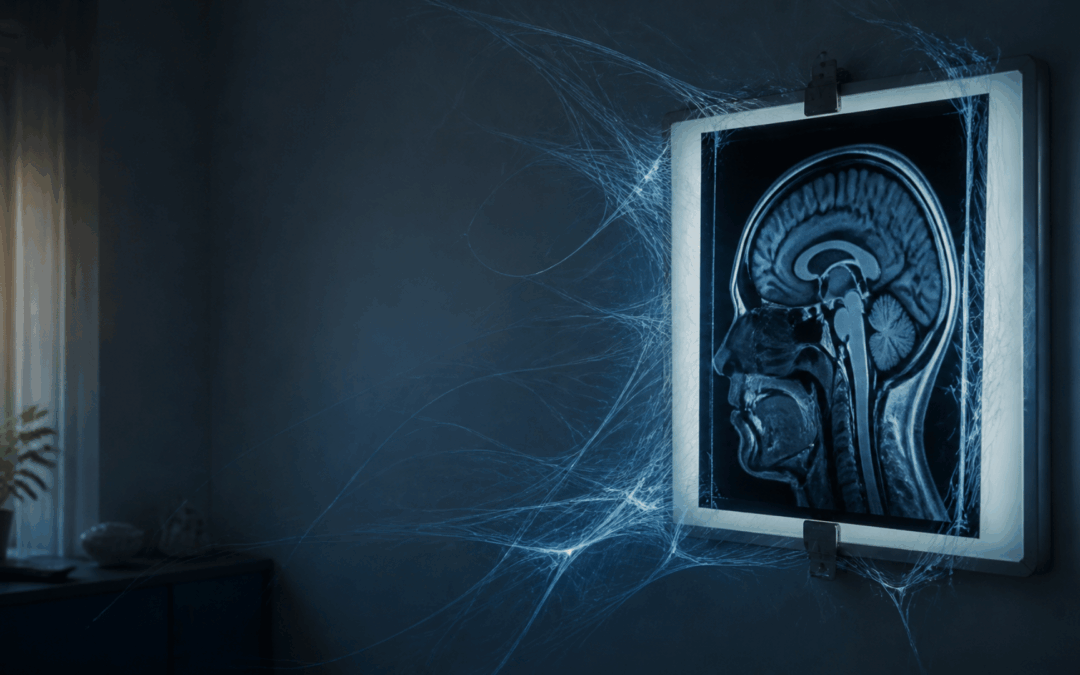
The scan was clear. You are not.
You rested.
You followed the protocol.
You waited.
Months later, the headaches are still there. The fog still rolls in by mid-afternoon. You wake up as tired as you went to bed. A conversation in a busy room costs you the rest of the day.
And every test says you are fine.
This is the experience of persistent post-concussion symptoms. It is one of the most common and least understood outcomes in brain injury. It is not a character flaw. It is not anxiety in disguise. It is not “in your head” in the way people mean when they say it.
It is in your system. That is a different problem, and it has a different solution.
What persistent post-concussion symptoms actually are
Persistent post-concussion symptoms, also called persistent post-concussion syndrome, describe symptoms that continue well past the point where recovery was expected. The pattern usually includes some combination of:
- Headaches and head pressure
- Brain fog and slowed thinking
- Memory lapses
- Fatigue and waking unrested
- Light and noise sensitivity
- Dizziness or poor balance
- Anxiety, low mood or irritability that was not there before
- Poor sleep
- Lost focus and lost drive
Here is the problem with the label. It describes duration. It does not describe cause.
“Persistent” tells you how long you have been stuck. It says nothing about why. When care is organized around a label that explains nothing, people are managed instead of corrected.
Why “give it time” stops working
In the first days after a concussion, rest is protective. It reduces demand on a brain in crisis. That advice is sound.
But time is not a treatment. It is a waiting period.
When symptoms outlast the recovery window, something important has happened. The nervous system has adapted to the injured state and is now holding it. The protective pattern that served you in week one has become the operating pattern in month six. Waiting longer does not interrupt that pattern. It reinforces it.
This is why so many people are told the same thing at every appointment, and why so many of them are still symptomatic two, five or ten years later.
It’s not that you’re not healing. It’s that your system is still holding the injury.
A concussion is not a single event in a single place. It is a load placed on an entire system. When symptoms persist, three layers of that load are usually still active at the same time.
1. Neurochemical load
After impact, the brain enters an energy crisis. Demand outruns supply. The chemical messaging that drives focus, memory, calm, mood and sleep becomes unstable. When the systems of dopamine, acetylcholine, GABA and serotonin stay dysregulated, you feel it as lost drive, forgetfulness, an alarm that will not switch off, and sleep that does not restore you.
2. Autonomic load
The nervous system is designed to shift between protection and recovery. After a concussion, many people get stuck in protection. Heart rate, breathing, digestion and sleep all stay organized around threat. Light feels harsher. Noise feels louder. Recovery never fully switches on, because the system does not believe it is safe to stop guarding.
3. Mechanical and sensory load
This is the layer almost no one assesses. Fascia is not packing material. It is a continuous sensory and force-transmission system that wraps the skull, the neck and every structure in between. An impact strong enough to concuss the brain is strong enough to change tension patterns in the cranial and craniocervical fascia.
When those restriction patterns persist, they keep feeding continuous signal into a nervous system that is already overloaded. Head pressure, neck tension and headaches are often where this layer shows itself. The pain may not be the source. Restriction is.
No standard scan is built to see any of these three layers. That is why the scan can be clear while you are not.
What you’re feeling is the output, not the cause.
This is the gap no one is addressing
Most concussion care manages one symptom at a time. Medication for the headaches. Something for sleep. Vision therapy for the eyes. Cognitive rest for the fog. Each of these has value. None of them addresses the system that produces every one of those symptoms together.
If fatigue, fog, poor sleep and low mood are outputs of one dysregulated system, treating them separately is managing outputs. You can manage outputs indefinitely. The system stays exactly where it is.
The question that changes the outcome is not “which symptom do we treat next?” It is “which part of the system is still holding the injury, and how do we correct it?”
What our published research shows
At the Fascia Training Institute, we do not ask anyone to take this on belief. We measure it.
Dynamic Brain Healing™: a published multi-practitioner case series
Our case series, Dynamic Brain Healing™ for Persistent Post-Concussive Symptoms: A Multi-Practitioner Case Series, was published in the Journal of Bodywork and Movement Therapies (Vol. 47, July 2026) and selected for oral presentation.
Twenty-nine people took part. Every one of them had post-concussive symptoms lasting more than a year. Each received two Dynamic Brain Healing™ treatments over three weeks, delivered by practitioners certified at Level 1.
| Outcome | Result | Significance |
|---|---|---|
| Memory difficulty | 78% of participants improved | p = 0.0001 |
| Waking unrested | 74% of participants improved | p = 0.0009 |
| Fatigue | 72% of participants improved | p = 0.0123 |
| Headaches | Significant decrease | p = 0.0052 |
| Cognitive fog | Significant decrease | p = 0.0099 |
| Head pressure | Significant decrease | p = 0.0238 |
| Brain Health Assessment neurotransmitter scores | Improved in all four: dopamine 32.1%, acetylcholine 19.4%, serotonin 18.2%, GABA 14.7% | All significant |
One finding matters more than any single number. Regression analysis showed that outcomes were independent of practitioner experience, client age and client sex.
That is the difference between a technique and a method. A technique lives in one person’s hands. A method transfers. Data collection continues as more practitioners are certified.
The Brain Reset Program: 230 people, measured over five years
Our Brain Reset Program outcomes white paper reviews every client who completed the Brain Health Assessment at least twice between 2021 and 2026. That is 230 people. 124 followed the Brain Reset Program. 106 retested without it. Both groups started at the same level.
| Brain Health Assessment measure | Brain Reset Program (n = 124) | Comparison (n = 106) |
|---|---|---|
| Starting score | 49.3 | 48.9 |
| Most recent score | 32.0 | 48.7 |
| Median change | 38.2% fewer symptoms | 2.9% change |
| Improved by 30% or more | 66.9% | 0% |
| Improved at all | 90.3% | 53.8% |
| All four neurotransmitter scores | Improved 31% to 40% | No score moved more than 1.4% |
Adjusted for starting score, program clients finished 16.9 points lower than the comparison group (p < 0.0001). The result held across seven sensitivity analyses and at every level of starting severity. The improvement appeared early and held for more than a year. The dopamine score, associated with focus and drive, showed the largest change at 40.1%.
One more finding deserves attention. In the comparison group, people with mild symptoms drifted slightly worse over time. Left alone, mild symptoms did not resolve.
The statistical analysis was performed independently by Shlomi Brielle, PhD. This is practice-based data, and group labels are being verified against enrollment records ahead of a prospective study. We report that openly. Measurement without honesty is marketing.
How the measures work. The Brain Health Assessment scores the four neurotransmitter systems, dopamine, acetylcholine, GABA and serotonin, through a structured inventory in which each question relates to a behavior or experience driven by that system. It is not a blood or urine test. In the Dynamic Brain Healing™ research it is paired with a 0–10 symptom inventory and balance testing, so change is tracked from more than one direction.

How Dynamic Brain Healing™ works
Dynamic Brain Healing™ is an assessment-led manual neurofascial method. It is the foundation of the clinical work at the Fascia Training Institute, and it is what separates this work from general fascia release.
- Assessment first. Treatment starts by identifying which cranial and craniocervical restriction patterns are still active, and how the nervous system responds to input.
- Low load, precise sequence. Inputs are gentle and deliberately ordered. Less is better. Force triggers protection. Precision allows release.
- Paced to the nervous system. Each step is matched to what the system can integrate, then reassessed before the next.
- Integrated with care. Dynamic Brain Healing™ does not manipulate brain tissue or claim to reverse structural injury. It complements neurological evaluation, rehabilitation and medical care.
You do not force change. You create the conditions for change.
How the Brain Reset Program works
The Brain Reset Program is a system recalibration process, not coaching or general support. It addresses five systems together, because they fail together.
- Neurochemical restoration for dopamine, serotonin, GABA and acetylcholine
- Autonomic regulation to move the nervous system out of chronic protection
- Cranial and fascial decompression to reduce mechanical and sensory load
- Inflammation reduction to quiet ongoing inflammatory signaling
- Brain-specific nutrition that works as food in a pill: unprocessed, with no fillers, where brand, dose and timing all matter
The process is structured and measurable:
- Brain Health Assessment. A 15-minute assessment establishes your baseline.
- Two 1:1 consultations. Your results are reviewed and your protocol is built around your pattern, including a review of the supplements you already take.
- Personalized Brain Reset protocol. Clear steps, implemented at home, delivered online.
- Reassessment at eight weeks. The same assessment, repeated. Lower scores mean fewer symptoms. You see the change in numbers, not impressions.
Who this is for
- You have had concussion symptoms for months or years, and your scans are clear
- You have had more than one concussion
- You have been told it will pass, or that it is stress, or that this is your new normal
- You are an athlete, executive or professional who can no longer perform at the level you know you are capable of
- You are tired of managing symptoms one at a time
When to see a physician first
Some symptoms need urgent medical evaluation before any other care. Seek emergency care for a worsening or severe headache, repeated vomiting, weakness or numbness, slurred speech, seizures, increasing confusion, or any sudden change after a new head impact. Dynamic Brain Healing™ and the Brain Reset Program work alongside medical care, not in place of it.
From the field
“As a Strength Coach for over 20 years, I have seen firsthand how Simone’s knowledge, expertise, and skills have directly improved my athletes’ performance. Her concussion prevention and management techniques have directly impacted my players and helped with return to court time.”
Preston Greene, Strength Coach, University of Miami Hurricanes
Frequently asked questions
Why won’t my concussion symptoms go away?
Because the system that produced them has not been corrected. When symptoms persist past the expected recovery window, the brain is usually still carrying neurochemical load, autonomic dysregulation and cranial and craniocervical fascial restriction. None of these show on a standard scan. Time does not resolve them on its own. Targeted correction does.
Can you recover from post-concussion symptoms years later?
Yes. Every participant in our published Dynamic Brain Healing™ case series had symptoms lasting more than a year. After two treatments over three weeks, 78% improved in memory difficulty, 74% in waking unrested and 72% in fatigue. Duration tells you how long the system has been stuck. It does not tell you the system cannot change.
What is Dynamic Brain Healing™?
Dynamic Brain Healing™ is an assessment-led manual neurofascial method developed by Simone Fortier at the Fascia Training Institute for persistent concussion-related symptoms. It uses low-load, sequenced manual inputs to the cranial and craniocervical fascial system, with reassessment throughout and pacing matched to the nervous system’s threshold. It does not manipulate brain tissue, and it complements medical care rather than replacing it.
What is the Brain Reset Program?
The Brain Reset Program is the Fascia Training Institute’s system-level recovery process for persistent concussion symptoms. It begins with the Brain Health Assessment, includes two 1:1 consultations and a personalized protocol covering brain-specific nutrition, nervous system regulation, cranial and fascial support and inflammation reduction, and ends with a reassessment at eight weeks. It is delivered online.
How is progress measured?
With the Brain Health Assessment, a 15-minute structured inventory that scores four neurotransmitter systems: dopamine, acetylcholine, GABA and serotonin. Lower scores mean fewer symptoms. You complete it at the start and again at eight weeks, so change is measured, not guessed.
What if I have had more than one concussion?
Multiple concussions usually mean more accumulated load, not a closed door. The approach is the same: measure the system, correct what is still dysregulated, and reassess.
Can I continue my other therapies?
Yes. The Brain Reset Program and Dynamic Brain Healing™ work alongside physiotherapy, vestibular therapy, vision therapy and medical care. We ask that you tell us about every medication and supplement you take.
Do I need to travel?
No. The Brain Reset Program is delivered online. Dynamic Brain Healing™ treatment is available in person in Scottsdale, Arizona, and Calgary, Alberta, and through practitioners certified by the Fascia Training Institute across Canada and the United States.
When the system changes, everything changes.
Persistent post-concussion symptoms are not proof that you cannot recover. They are proof that the system has not been corrected yet.
The scan measured structure. It was never designed to measure load. This is where it changes.
Start with the Brain Reset Program
$1,197 USD, delivered online. It includes the Brain Health Assessment, two 1:1 consultations, your personalized Brain Reset protocol and a reassessment at eight weeks.
If your eight-week reassessment shows no improvement and you followed the program exactly as directed, your third consultation and a revised program are provided at no cost. Ten new clients are accepted each month.
Train in Dynamic Brain Healing™
Level 1 clinical certification is in person, and it is required for every practitioner, physicians included. Upcoming Level 1 dates: Tampa, Florida, December 11–13, 2026; Phoenix, Arizona, January 8–10, 2027; Calgary, Alberta, May 14–16, 2027.
Every case you complete in certification adds to the research.
References
- Fortier S. Dynamic Brain Healing™ for Persistent Post-Concussive Symptoms: A Multi-Practitioner Case Series. Journal of Bodywork and Movement Therapies. 2026;47:709–710. doi:10.1016/j.jbmt.2025.11.149
- Fortier S. Brain Reset Program: Outcomes White Paper. Fascia Training Institute. October 2026. Statistical analysis by Shlomi Brielle, PhD.
About the author
Simone Fortier, BSc, is the founder of the Fascia Training Institute and the developer of Dynamic Brain Healing™, the Brain Reset Program and the Brain Health Assessment. Over more than 30 years she has treated more than 30,000 people, including elite athletes from the NFL, NHL and Olympic programs, and trained approximately 250 healthcare practitioners across Canada and the United States. Her post-graduate training includes Functional Neurology through the Carrick Institute and Concussion Management through Laval University. Her multi-practitioner case series on persistent post-concussive symptoms was published in the Journal of Bodywork and Movement Therapies in 2026.