
By Simone Fortier, BSc, Founder, Fascia Training Institute
The short answer
The best treatment for persistent concussion symptoms is one that corrects the system still holding the injury, not one that manages symptoms one at a time. It must pass four tests: it addresses the whole system, it is measured before and after, it works years after the injury, and its results do not depend on one practitioner’s hands.
Dynamic Brain Healing™ is the method created specifically for persistent post-concussion symptoms. In a peer-reviewed case series published in the Journal of Bodywork and Movement Therapies (2026), 29 people with symptoms lasting more than a year received two treatments over three weeks. 78% improved in memory difficulty, 74% in waking unrested and 72% in fatigue.
You asked for the best treatment. You got a list.
Search the question and you get the same answer in different fonts.
Exercise. Vestibular therapy. Vision therapy. Neck rehab. Mindfulness. Brain stimulation. Medication.
Seven options. Seven providers. Seven appointments.
If you are reading this, you have probably tried several of them. Some helped. Some helped for a while. And you are still searching, because you are still not yourself.
That is not a failure of effort. It is a failure of the question being answered.
Why every list gets this question wrong
A list of treatments answers a different question. It answers “what can be done about each symptom?” Headaches go here. Dizziness goes there. Sleep goes somewhere else.
But persistent concussion symptoms are not seven separate problems. They are outputs of one system that never finished recovering. The fog, the fatigue, the head pressure, the broken sleep and the short fuse are what that system feels like from the inside.
Rank the outputs and you get a list. Correct the system and the list gets shorter on its own.
It’s not that the treatments failed you. It’s that none of them were asked to correct the system.
The four tests a real answer must pass
“Best” is not a popularity contest. For persistent symptoms, it is a standard. Any treatment you consider, including ours, should be held to these four tests.
Test 1: It addresses the system, not one symptom
If a treatment targets one symptom, expect one symptom to change. Persistent symptoms come from neurochemical load, autonomic dysregulation and mechanical and sensory load acting together. A real answer works on the system that produces all of them.
Test 2: It is measured before and after
“How do you feel?” is not a measurement. A real answer establishes a baseline, repeats the same measure, and shows you the change in numbers. If a provider cannot show you what moved, neither of you knows whether it worked.
Test 3: It works years after the injury, not only in the first weeks
Much of concussion research studies the first days and weeks. That is not who is searching for this answer. You need evidence from people whose symptoms had already outlasted every expected recovery timeline.
Test 4: Its results do not depend on one practitioner
Some clinicians get remarkable results that nobody else can reproduce. That is a gifted practitioner, not a reliable treatment. A real method produces results that transfer, so you get the same standard of care wherever you receive it.
What the common treatments address
Each of these has a place. Keep the ones that are helping you. The point is to see clearly what each one is designed to target.
| Treatment | Primary target |
|---|---|
| Graded aerobic exercise | Exercise tolerance and heart-rate regulation |
| Vestibular rehabilitation | Dizziness and balance |
| Vision therapy | Eye tracking and visual strain |
| Neck (cervical) rehabilitation | Neck pain and neck-driven headaches |
| Mindfulness and psychological therapy | Stress response and coping |
| Transcranial magnetic stimulation | Activity in targeted brain regions, often for mood |
| Medication | Individual symptoms such as pain, sleep or mood |
Look at the right-hand column. Every entry is a part. None of them is the whole. And one layer does not appear at all.
This is the gap no one is addressing
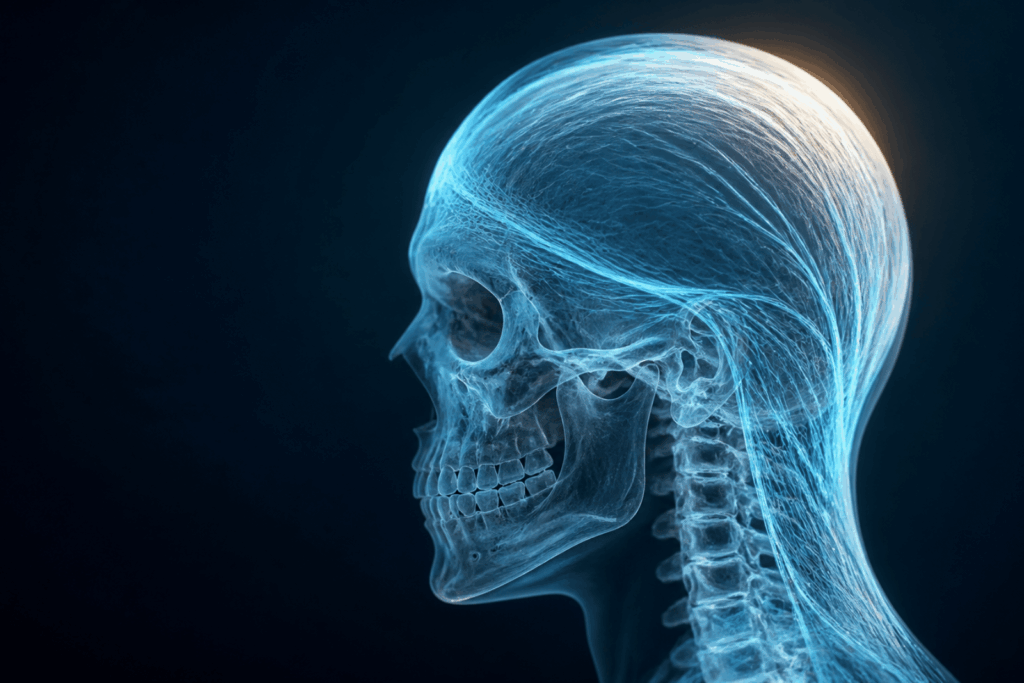
Fascia is a continuous sensory and force-transmission system. It wraps the skull, runs through the neck and connects to every structure in between. An impact strong enough to concuss the brain is strong enough to change tension patterns in the cranial and craniocervical fascia.
When those restriction patterns persist, they keep feeding signal into a nervous system that is already overloaded. The head pressure, the band of tension, the headache that starts in the neck and wraps forward: these are often where this layer shows itself.
Neck rehabilitation touches part of it. Nothing on the standard list assesses the cranial and craniocervical fascial system as one continuum. That is why relief so often fades. The part that was treated improved. The system that holds it did not change.
The pain may not be the source. Restriction is.
Dynamic Brain Healing™: built for this exact question
Dynamic Brain Healing™ was not adapted to concussion from another purpose. It was created specifically for persistent post-concussion symptoms, from more than 30 years of clinical work and more than 30,000 people treated, including athletes in the NFL, the NHL and Olympic programs.
It is an assessment-led manual neurofascial method. Treatment begins by identifying which cranial and craniocervical restriction patterns are still active. Inputs are low-load and precisely sequenced. Less is better, because force triggers protection and precision allows release. Each step is paced to what the nervous system can integrate, then reassessed. It does not manipulate brain tissue, and it works alongside medical care.
Here is how it performs against the four tests, using our published case series of 29 people.
| The test | The evidence |
|---|---|
| 1. Addresses the system | Symptoms improved across domains at once: memory, sleep quality, fatigue, headaches, fog and head pressure. Brain Health Assessment scores improved in all four neurotransmitter systems. |
| 2. Measured before and after | The Brain Health Assessment and symptom ratings were recorded before and after treatment. Memory difficulty p = 0.0001; waking unrested p = 0.0009; headaches p = 0.0052. |
| 3. Works years later | Every participant had symptoms for more than a year. Results came after two treatments over three weeks. |
| 4. Does not depend on one practitioner | Treatments were delivered by Level 1-certified practitioners. Regression analysis showed outcomes were independent of practitioner experience, client age and client sex. |
Test 4 is the one most treatments cannot pass. A technique lives in one person’s hands. A method transfers. Data collection continues as more practitioners are certified.
Where the Brain Reset Program fits
Dynamic Brain Healing™ corrects the mechanical and sensory layer. The Brain Reset Program corrects the neurochemical and autonomic layers, with brain-specific nutrition that works as food in a pill, nervous system regulation and inflammation reduction. Together they cover the system, not a symptom.
The Brain Reset Program has its own measured outcomes. In a review of 230 people who completed the Brain Health Assessment at least twice, those who followed the program reported a median of 38% fewer symptoms. 66.9% improved by 30% or more. People who retested without the program started at the same level and did not change.
Questions to ask any provider before you start
Use these with any clinician, for any treatment. The answers will tell you more than any list.
- What is driving my symptoms, not just which symptoms do I have?
- How will you measure my starting point, and how will we know it changed?
- What results have you seen in people whose symptoms lasted more than a year?
- Is your approach published, and would another practitioner trained in it get the same results?
- What part of my system does this treatment not address, and who addresses it?
- When will we reassess, and what happens if nothing has moved?
A clinician who welcomes these questions is a clinician worth seeing.
When to see a physician first
Seek emergency care for a worsening or severe headache, repeated vomiting, weakness or numbness, slurred speech, seizures, increasing confusion, or any sudden change after a new head impact. Persistent symptom care works alongside medical evaluation, never in place of it.
Frequently asked questions
What is the best treatment for persistent concussion symptoms?
The best treatment is one that corrects the system still holding the injury rather than managing symptoms one at a time. It should address the whole system, be measured before and after, work years after injury, and produce results that do not depend on one practitioner. Dynamic Brain Healing™ was created specifically for persistent post-concussion symptoms and is supported by a peer-reviewed case series published in the Journal of Bodywork and Movement Therapies in 2026.
How long do persistent concussion symptoms last?
They can last months or years when the underlying system is not corrected. Duration describes how long the system has been stuck. It does not predict whether it can change. Every participant in the published Dynamic Brain Healing™ case series had symptoms for more than a year, and most improved after two treatments over three weeks.
Can persistent concussion symptoms be treated years later?
Yes. In the published case series, people with symptoms lasting more than a year improved after two Dynamic Brain Healing™ treatments: 78% in memory difficulty, 74% in waking unrested and 72% in fatigue. In the 230-person Brain Reset Program outcomes review, improvement held for more than a year.
Is Dynamic Brain Healing™ the same as craniosacral therapy?
No. Dynamic Brain Healing™ is an assessment-led neurofascial method created specifically for persistent post-concussion symptoms. It assesses the cranial and craniocervical fascial system as one continuum, uses low-load sequenced inputs paced to the nervous system, reassesses throughout, and has its own published outcome data.
Can I keep doing vestibular therapy, vision therapy or physiotherapy?
Yes. Dynamic Brain Healing™ and the Brain Reset Program work alongside other therapies and medical care. Keep what is helping. Add what addresses the layer those therapies do not assess.
Where can I get Dynamic Brain Healing™?
Simone Fortier treats in person in Scottsdale, Arizona, and Calgary, Alberta. Practitioners certified by the Fascia Training Institute treat across Canada and the United States. The Brain Reset Program is delivered online, anywhere.
The best treatment is the one that changes the system.
Not the longest list.
Not the most appointments.
Not another month of waiting.
A treatment that addresses the whole system. That measures what it changes. That works years after the injury. That produces the same result in any certified hands.
That is the standard. Dynamic Brain Healing™ was built to meet it. When the system changes, everything changes.
Your next step
Start with the Brain Reset Program. $1,197 USD. The Brain Health Assessment, two 1:1 consultations, your personalized protocol and reassessment at eight weeks, delivered online. If your reassessment shows no improvement and you followed the program exactly as directed, your third consultation and a revised program are provided at no cost. Ten new clients are accepted each month.
Find a certified Dynamic Brain Healing™ practitioner in the United States or Canada.
Begin your Brain Reset Program
Train in Dynamic Brain Healing™
Level 1 clinical certification is in person, and it is required for every practitioner, physicians included. Upcoming Level 1 dates: Tampa, Florida, December 11–13, 2026; Phoenix, Arizona, January 8–10, 2027; Calgary, Alberta, May 14–16, 2027.
Every case you complete in certification adds to the research.
References
- Fortier S. Dynamic Brain Healing™ for Persistent Post-Concussive Symptoms: A Multi-Practitioner Case Series. Journal of Bodywork and Movement Therapies. 2026;47:709–710. doi:10.1016/j.jbmt.2025.11.149
- Fortier S. Brain Reset Program: Outcomes White Paper. Fascia Training Institute. October 2026. Statistical analysis by Shlomi Brielle, PhD.
About the author
Simone Fortier, BSc, is the founder of the Fascia Training Institute and the developer of Dynamic Brain Healing™, the Brain Reset Program and the Brain Health Assessment. Over more than 30 years she has treated more than 30,000 people, including elite athletes from the NFL, NHL and Olympic programs, and trained approximately 250 healthcare practitioners across Canada and the United States. Her post-graduate training includes Functional Neurology through the Carrick Institute and Concussion Management through Laval University. Her multi-practitioner case series on persistent post-concussive symptoms was published in the Journal of Bodywork and Movement Therapies in 2026.