
Why Traditional Stretching Fails: A Fascia-Based Approach to Mobility Restoration
The Hidden Reason Stretching Fails
A Fascia-Based Approach to Mobility Restoration Used by Performance Practitioners
For decades, stretching education has followed a simple assumption:
If tissue feels tight, stretch it.
Most protocols taught in rehabilitation, fitness, and manual therapy programs apply bilateral stretching — the same sequence on both sides of the body.
But human movement doesn’t organize itself that way.
The body is asymmetric.
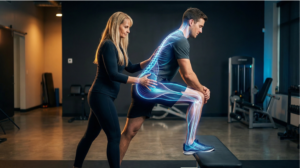
Fascia twists, compensates, and redistributes tension throughout the kinetic chain. When practitioners apply symmetrical stretching to an asymmetric system, the underlying restriction often remains.
In many cases, the “tight muscle” isn’t the true restriction at all.
It’s compensation.
Understanding how to identify and release these patterns is the foundation of Fascia Release & Dynamic Stretch training.
Fascia: The Body’s Integrated Tension Network
Fascia is not simply connective tissue surrounding muscles.
It forms a continuous three-dimensional tension network connecting muscles, joints, ligaments, and neural structures.
This network distributes mechanical load across the body through interconnected fascial chains.
When mobility is lost in one region, tension is redistributed elsewhere.
This explains why clinicians often observe cases such as:
- chronic hamstring tightness originating from pelvic restriction
• shoulder impingement linked to thoracic mobility limitations
• recurring calf tension driven by hip dysfunction
• lumbar stiffness connected to fascial restrictions higher in the chain
When stretching focuses only on the symptomatic area, the underlying fascial driver often remains unresolved.
The Asymmetry Principle
One of the most overlooked truths in movement therapy is simple:
Every body is asymmetric.
Postural habits, sport-specific loading, injury history, and neurological adaptation create unique tension patterns across the fascial system.
These asymmetries mean:
- one side of the body frequently carries greater fascial load
• compensation chains often run diagonally through the body
• the perceived tight area may not be the primary restriction
For practitioners working with athletes and active populations, recognizing these patterns is essential for restoring mobility and improving performance.
Fascia Release & Dynamic Stretch: A Clinical Approach
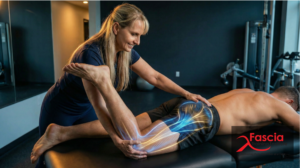
The Fascia Release & Dynamic Stretch system was developed to help practitioners address fascial compensation patterns through a structured process.
Rather than applying generic stretching protocols, the method integrates four essential components.
Asymmetric Fascial Assessment
Practitioners learn to identify the true driver of restriction within the fascial network.
Targeted Fascial Release
Directional loading techniques are applied to restore mobility along the affected fascial chain.
Dynamic Stretch Integration
Movement-based stretch sequences retrain neuromuscular coordination within the new range of motion.
Functional Reintegration
Improved mobility is transferred into functional movement patterns relevant to sport and daily activity.
For athletes, this integrated approach often produces more durable mobility gains than traditional static stretching alone.
Why Performance Practitioners Are Turning to Fascia-Based Methods
Sports medicine clinicians frequently encounter athletes who have already tried:
- traditional stretching programs
• mobility routines
• massage therapy
• strengthening protocols
Yet mobility restrictions persist.
Fascial-based treatment models offer a way to examine these unresolved cases by evaluating how tension is distributed across the entire system.
Instead of treating isolated muscles, practitioners begin to treat movement patterns and fascial chains.
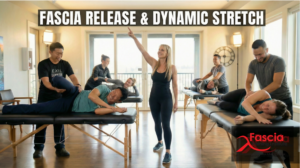
Fascia Release & Dynamic Stretch Practitioner Training
To help clinicians apply these concepts in practice, the Fascia Training Institute offers hands-on education programs designed specifically for experienced professionals.
Courses are built for:
- chiropractors
- physiotherapists
- manual therapists
- athletic trainers
- strength and conditioning coaches
- Pilates and yoga instructors
- rehabilitation professionals
Each training focuses on practical application rather than theory alone.
Practitioner Training Locations
Calgary Fascia Release & Dynamic Stretch Course
The Calgary training builds on the foundation by refining:
- fascial compensation analysis
• movement integration strategies
• practitioner assessment skills
Participants deepen their ability to identify the true driver of mobility restriction.
Phoenix Fascia Release & Dynamic Stretch Course
The Phoenix training introduces the core system including:
- asymmetric fascial assessment
• release techniques for major fascial chains
• dynamic stretch protocols for upper and lower body mobility
This course provides the foundational skillset practitioners need to begin applying fascia-based mobility work in clinical or performance environments.
Tampa Fascia Release & Dynamic Stretch Course
For practitioners seeking advanced mastery, the certification program in Tampa, Florida provides the most comprehensive training.
The advanced certification includes:
- advanced fascial chain assessment
• complex restriction pattern analysis
• performance and rehabilitation integration
• practitioner clinical application strategies
Participants earn certification upon completion and gain tools designed for high-performance clinical environments.
Learn more about the advanced program:
https://www.fasciatraininginstitute.com/practitioners/advanced-fascia-release-dynamic-stretch-certification-tampa-florida/
The Future of Mobility Training
Movement science continues to evolve toward system-based approaches to mobility restoration.
Understanding fascial tension patterns allows practitioners to treat the mechanical driver of dysfunction rather than the symptom.
For clinicians working with athletes, this shift can transform how chronic mobility restrictions are assessed and resolved.
The next generation of mobility professionals will not simply stretch muscles.
They will read and restore fascial patterns.
Upcoming Fascia Release & Dynamic Stretch Courses
Phoenix, Arizona
Calgary, Canada
Advanced Certification — Tampa, Florida
Each course is designed to provide hands-on education that practitioners can immediately integrate into clinical or performance practice.
FAQ
What is fascia release therapy?
Fascia release therapy is a manual and movement-based treatment approach designed to restore mobility by addressing restrictions within the body’s fascial network.
What is dynamic stretch training?
Dynamic stretch training combines fascial release with active movement sequences to improve mobility while retraining the nervous system to move within the new range.
Who should take a fascia training course?
Fascia training courses are designed for chiropractors, physiotherapists, manual therapists, athletic trainers, strength coaches, and rehabilitation professionals. Pilates and Yoga instructors.
Why does stretching sometimes fail?
Stretching often fails because the tight muscle may be compensating for a restriction elsewhere in the fascial system.