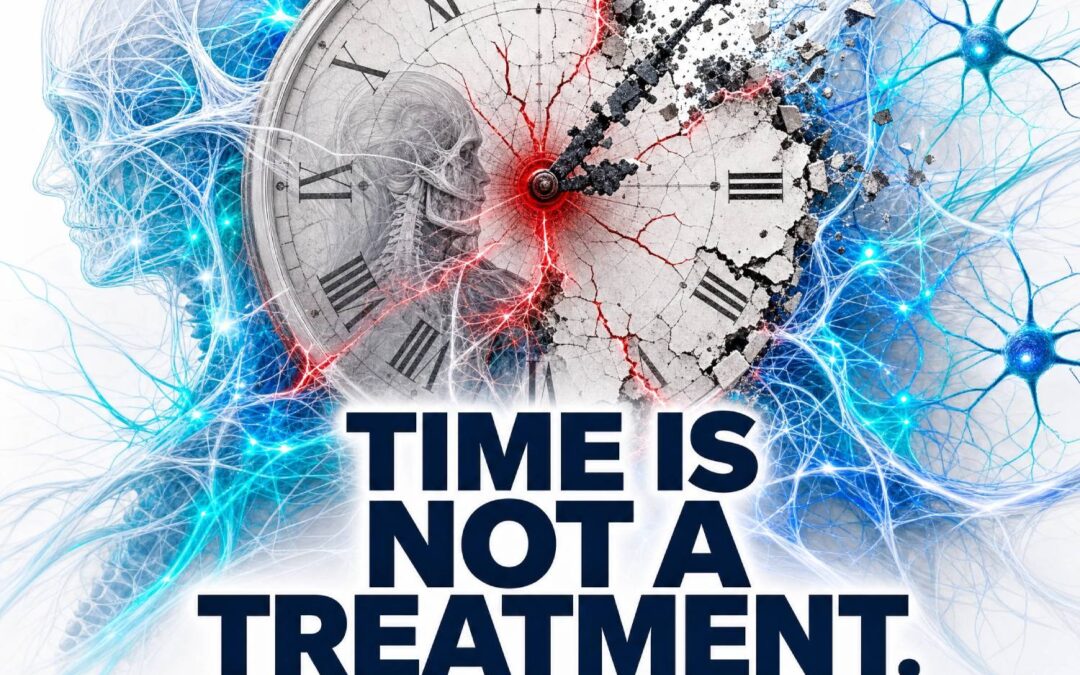
Time Is Not a Treatment
Why the Most Dangerous Protocol in Medicine Is the One Nobody Questions
“Time heals all things.”
It is one of the oldest beliefs in human culture. Repeated in emergency rooms. Written into rehabilitation timelines. Embedded so deeply in the language of medicine that no one stops to question whether it is true.
Give it time. Let it rest. Wait it out.
And on the surface, it appears to work. The pain subsides. The swelling resolves. The symptoms quiet. The clinician documents recovery.
But I have spent more than thirty years working at the highest levels of human performance — NFL, NHL, Olympic-level athletes, complex neurological cases, trauma survivors, high-performing executives — and I have seen what lives on the other side of “giving it time.”
It is not recovery.
It is the most organized form of dysfunction the human body is capable of producing.
Because time does not heal.
Time does one thing, and it does it well:
It moves you farther from the experience.
Distance is not repair. Distance is not restoration.
Distance is the brain’s way of telling you it has stopped paying attention to the problem.
The problem is still there.
What the Body Actually Does While You Wait
The medical model operates on an implicit assumption: if you protect the injured tissue and give the body enough time, the body will restore itself to its pre-injury state.
This assumption is incorrect.
The body does not restore itself. The body reorganizes itself. These are fundamentally different biological outcomes.
When tissue is injured — a fracture, a ligament tear, a concussive impact, a surgical intervention — the system launches an immediate survival response. Not a repair response. A survival response.
Fascia — the continuous connective tissue matrix that surrounds every muscle, organ, nerve, and bone — begins laying down emergency collagen within hours. This collagen is dense, disorganized, and fibrotic. It is not designed to restore function. It is designed to stabilize the area as fast as possible, at any cost to mobility, elasticity, or performance.
The nervous system simultaneously rewires around the damage. Motor pathways are rerouted. Muscle activation sequences are altered. Load distribution shifts. The brain remaps movement not for efficiency, but for avoidance.
The autonomic nervous system shifts into a sustained protective state. Sympathetic tone increases. Parasympathetic capacity — the system that governs recovery, sleep, digestion, and immune function — is downregulated.
Every one of these responses is active. Purposeful. Automatic.
And every one of them deepens with time.
Every day that passes without targeted intervention, the fibrotic collagen matures and cross-links. The neural rerouting becomes more entrenched. The motor patterns become more automated. The autonomic bias becomes more fixed.
What the patient calls “healing” is the system building a permanent workaround.
The system will always choose stability over performance. Protection over freedom. Restriction over vulnerability. That is the design working exactly as intended.
But survival and high-level function are not the same outcome.
And the longer the workaround runs unopposed, the more the system treats it as permanent architecture.
Concussion: How the Brain Hides Its Own Dysfunction
There is no better example of false resolution than concussion.
In the acute phase, the crisis is visible. Headache. Light sensitivity. Cognitive fog. Emotional lability. Vestibular disruption. The system is in alarm, and everyone can see it.
The standard protocol: rest, darkness, reduced stimulation, wait.
Within weeks — sometimes months — the acute symptoms diminish. The patient reports feeling better.
The protocol says: recovered.
The system tells a different story.
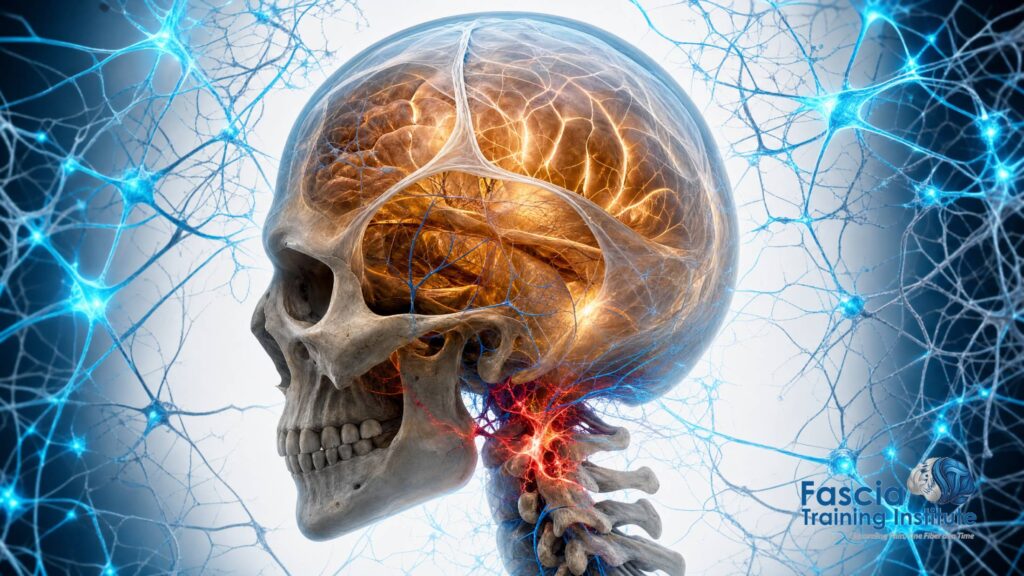
At the moment of impact, the brain experienced rapid acceleration and deceleration forces. The meningeal fascia — the dural membranes that suspend the brain within the cranial vault — absorbed and transmitted that force across the entire cranial architecture. The falx cerebri and tentorium cerebelli shifted under mechanical load. The dural attachments at C1, C2, and the sacrum were pulled into asymmetry. The cervical fascia is locked into protective contraction. The deep cervical flexors were neurologically inhibited.
None of this has an internal timer counting down to self-correction. There is no biological mechanism by which dural tension spontaneously resolves. There is no passive process that re-educates inhibited deep cervical flexors.
What happens is that the prefrontal cortex gradually reasserts inhibitory control over the amygdala’s threat response. The somatosensory cortex stops reporting the damage. The motor cortex automates the compensatory patterns until they no longer require conscious effort.
The brain did not resolve the injury. It suppressed the alarm.
Six months later, the patient cannot sustain focus under pressure. Sleep has deteriorated. Emotional reactivity has increased. Exercise tolerance has quietly declined. Headaches return under stress.
But they do not connect any of this to the concussion. Because the medical model said they healed. Because time passed.
Because the brain reclassified unresolved dysfunction as the new baseline — and the medical model mistook silence for resolution.
Grief: The Trauma That Lives in the Tissue
This is not limited to structural injury.
When a human being experiences profound loss — death, separation, identity rupture — the neurological response is physiologically indistinguishable from physical trauma.
The amygdala activates the same threat pathways. The hypothalamic-pituitary-adrenal axis launches the same stress cascade. Cortisol, adrenaline, and inflammatory cytokines flood the system. The autonomic nervous system shifts into the same sustained protective state.
And fascia — which responds to neurochemical input as directly as it responds to mechanical force — contracts.
Grief is not an emotion that floats above the body.
Grief is a full-system physiological event.
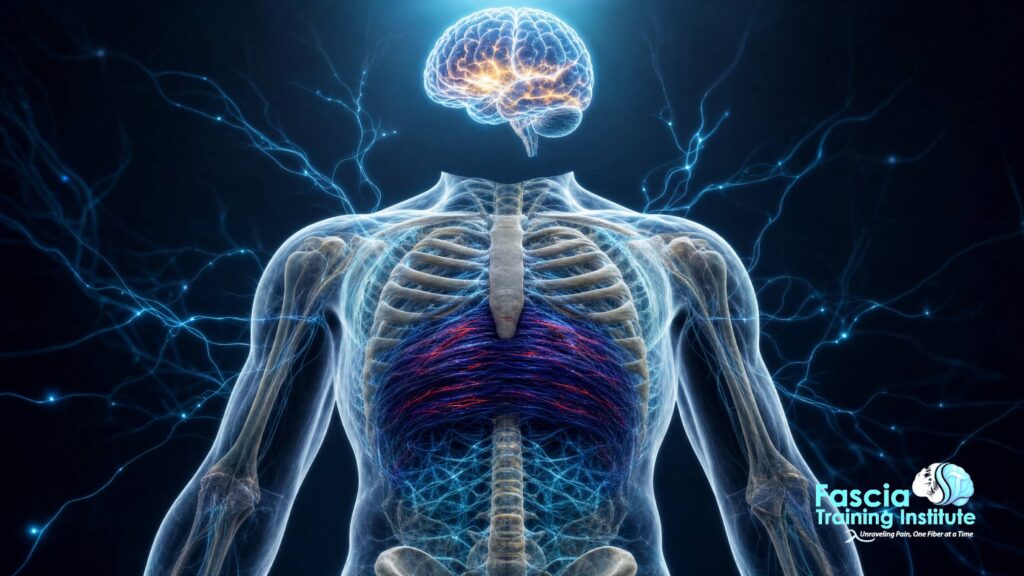
The diaphragm restricts. Breathing migrates from deep abdominal expansion to shallow thoracic patterning — and stays there. The thoracolumbar fascia locks. The deep front line tightens from the pelvic floor through the psoas, through the diaphragm, through the pericardial fascia, and into the cervical spine. Vagal tone drops. The gut-brain axis is disrupted. Sleep architecture deteriorates. Immune surveillance declines.
And people say, “Give it time.”
What time does is allow the prefrontal cortex to reassert executive control over the alarm response. The acute emotional flooding subsides. The person returns to work. Resumes social engagement. Appears, by every external metric, to have moved on.
But the fascial restrictions are still there. The breathing pattern is still altered. The autonomic bias is still shifted. The vagal tone is still suppressed.
The person is functional.
They are not healed.
They have reorganized their entire life around a system that is still holding the full physiological imprint of the loss. And because enough time passed, no one — not the person, not their physician, not their therapist — thinks to look at the body.
This is the distinction that changes everything:
The brain can decide to move on.
Fascia does not have that option.
The brain forgets. The fascia remembers.
And no amount of time changes that equation.
The Knee: One Uncorrected Failure, Five Breakdowns
The third dimension of false resolution is the cascade.
A ligament tears. Surgery repairs the structure. Rehabilitation follows the standard timeline: protect, progressively load, strengthen, return.
At twelve months, the range of motion is acceptable. Strength metrics fall within normal limits. The surgeon signs off.
But the system was never corrected.
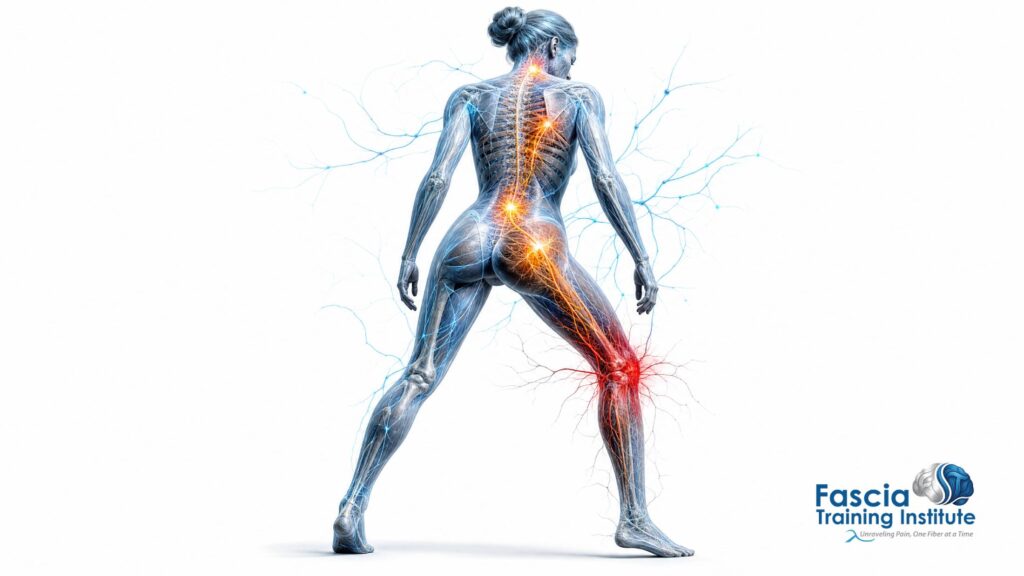
The fascial adhesions that formed between the joint capsule and the periarticular connective tissue during healing were never addressed. The Arthrogenic Muscle Inhibition — the brain’s neurological shutdown of the musculature surrounding the injured joint — was never cleared. The mechanoreceptors in the periarticular fascia are buried in adhesion. The brain is making motor decisions with degraded input.
The athlete returns to play. Compensates. Shifts load to the contralateral limb. Develops asymmetry patterns that distribute force incorrectly across the kinetic chain.
Eighteen months later, the other knee breaks down. Two years later, the hip compensates. Three years later, the lumbar spine degenerates.
Every clinician along the way treats each of these as a new, unrelated injury.
None of them are new.
They are the long-term consequence of one uncorrected system failure — given enough runway by the belief that time was handling it.
The original injury was “healed” three years ago. The cascade it produced is still unfolding.
The Fascia Remembers What the Brain Forgets
This is the clinical reality that separates system-level practice from conventional rehabilitation.
The brain can suppress conscious awareness of trauma. It can reclassify the threat. It can automate the workaround until the person no longer notices it.
But fascia is a mechanical system. It cannot suppress its own state.
It holds the exact structural consequence of every unresolved event, regardless of how much time has passed, how successfully the brain has suppressed the memory, or how “normal” the person feels.
This is why a patient can present with a shoulder restriction that traces back to an abdominal surgery fifteen years ago. The brain forgot about the surgery. The fascia did not. Adhesion in the anterior abdominal wall altered the tension of the deep front line. That changed the diaphragm’s mechanics. That restricted the thoracic spine. That shifted the scapular position. That created the impingement.
Fifteen years of layered adaptation. And at no point in those fifteen years did time resolve the original restriction.
Time made it invisible.
The fascia kept it operational.
The Fundamental Error: Symptom Absence Is Not System Restoration
The conventional model measures recovery by one metric: the absence of reported symptoms.
If the patient no longer reports pain, the injury is healed. If cognitive symptoms have resolved, the concussion is cleared. If functional benchmarks are met, rehabilitation is complete.
But the absence of symptoms and system restoration are two entirely different clinical realities.
A patient can have zero reported symptoms and still have fascial adhesions restricting tissue glide across three joint complexes. A patient can pass every return-to-play test and still have neural inhibition suppressing full motor drive to the stabilizers around the injured joint. A patient can feel “completely normal” and still have an autonomic nervous system locked in low-grade sympathetic dominance — eroding sleep, stress tolerance, and immune function in the background.
The symptoms resolved because the brain stopped reporting them.
The dysfunction persisted because the body had no mechanism to self-correct it.
This is the space between feeling healed and being healed.
One is a perceptual construction — the brain’s editorial decision about what deserves conscious attention.
The other is a measurable, structural, functional, neurological reality.
Time gives you the first.
Only targeted, system-level intervention gives you the second.
What Real Healing Requires
If time is not a treatment — and it is not — then what is?
Healing at the system level requires three things that time alone cannot provide.
The fascial architecture must be physically restored.
Not stretched. Not mobilized. Not forced through range. Restored. The fibrotic collagen must be rehydrated and remodeled. The adhesions between tissue planes must be released to re-establish independent glide. The elastic recoil of the fascial web must be recovered. This requires precise, non-force, manual intervention that works with the tissue’s own reorganizational capacity — not against it.
The nervous system must be neurologically re-educated.
The motor cortex must remap movement patterns altered at the time of injury. The autonomic bias must shift from sustained protection back toward regulation and adaptability. This does not happen through progressive loading. It happens through restoring the quality of sensory input — primarily from the fascial mechanoreceptors — that the brain uses to determine whether the system is safe enough to release its protective hold.
The trauma encoding must be cleared from the system.
The amygdala’s threat tag. The somatosensory cortex’s damage map. The motor cortex’s avoidance patterns. These must be neurologically released — not overridden with willpower, not masked with medication. Released at the level where the pattern is stored, through interventions that access the brain-fascia interface directly.
This is what we do at the Fascia Training Institute.
Not time-based protocols. Not phase-based progression. Not symptom management.
System-level correction.
We do not wait for the body to heal itself. We create the conditions under which the system can reorganize toward function — not just survival.
What Thirty Years Has Made Clear
I have worked with athletes who were cleared by the best sports medicine teams in the world — and whose systems were still running the injury pattern from two years prior. The clearance was based on imaging and functional testing. Neither captures fascial restriction, neural inhibition, or autonomic dysregulation.
I have worked with executives who came in for chronic headaches and walked out understanding that what they were experiencing was the accumulated neurofascial consequence of a car accident from a decade ago, compounded by sustained high-stress performance — none of which had ever been addressed at the system level.
I have worked with individuals who believed they had “moved past” a traumatic event — and whose fascia, breathing pattern, and autonomic tone told a completely different story.
The people who “gave it time” are the ones with layers of compensation so deep that the original event is buried under five secondary breakdowns. Not because they did anything wrong. Because the model they trusted was never designed to address the system.
The Question That Changes Everything
The next time someone tells you to give it time, ask one question:
Is the system healing? Or is it building a more sophisticated workaround?
Because the brain will make adaptation feel like healing. It will construct the experience of resolution by suppressing the signals that would tell you the system is still compromised.
But feeling healed and being healed are two different neurological states.
And only one of them leads to recovery.
Time is not a treatment.
It never was.
When the system changes, everything changes.
Founder, Fascia Training Institute
Creator of Dynamic Brain Healing™, Quantum NeuroFascial Release™, and the Brain Reset Program. Over 30 years of clinical experience with elite athletes (NFL, NHL, Olympic-level), complex neurological cases, and high-performing professionals. Operating at the intersection of neuroscience, fascial science, and human performance.