Recovery Isn’t a Guess Anymore
What new predictive data means for return-to-play protocols, and why ‘rest in a dark room’ is now a liability position, not a safe one
For decades, return-to-play decisions have rested on two tools: a structural scan and a symptom checklist. Both are now measurably out of date — and both carry real exposure for the program relying on them.
The Prediction Problem Just Got Solved
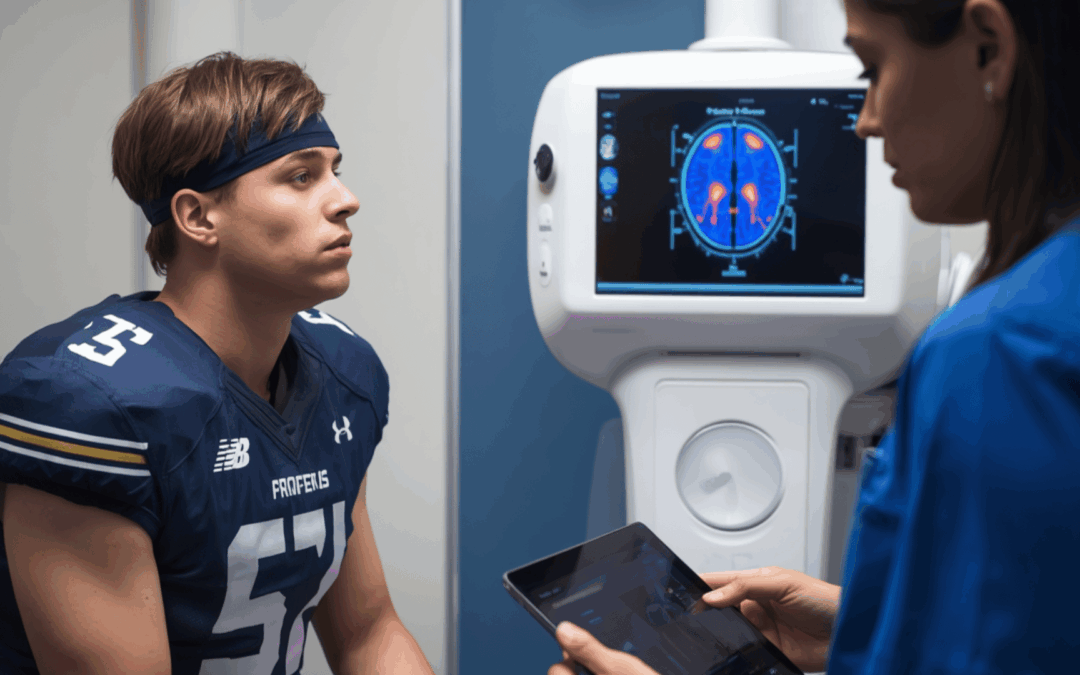
A study funded by the National Institute of Biomedical Imaging and Bioengineering used diffusion MRI to measure water movement through white matter tracts in college athletes and predicted, with 90% accuracy, which athletes would face prolonged recovery — more than 28 days with persistent symptoms. That figure outperformed the standard clinical symptom checklist most programs still rely on for clearance decisions. The study is early — 51 injuries across 45 athletes, with a larger trial planned — but the finding itself isn’t in question: recovery trajectory is a measurable systems signal, not a subjective self-report.
That reframes what a subjective checklist actually is in a return-to-play conversation. It isn’t a neutral placeholder for the technology that doesn’t exist yet. It’s a documented choice to use a less accurate method when a more accurate one exists.
The Clinics Have Already Moved
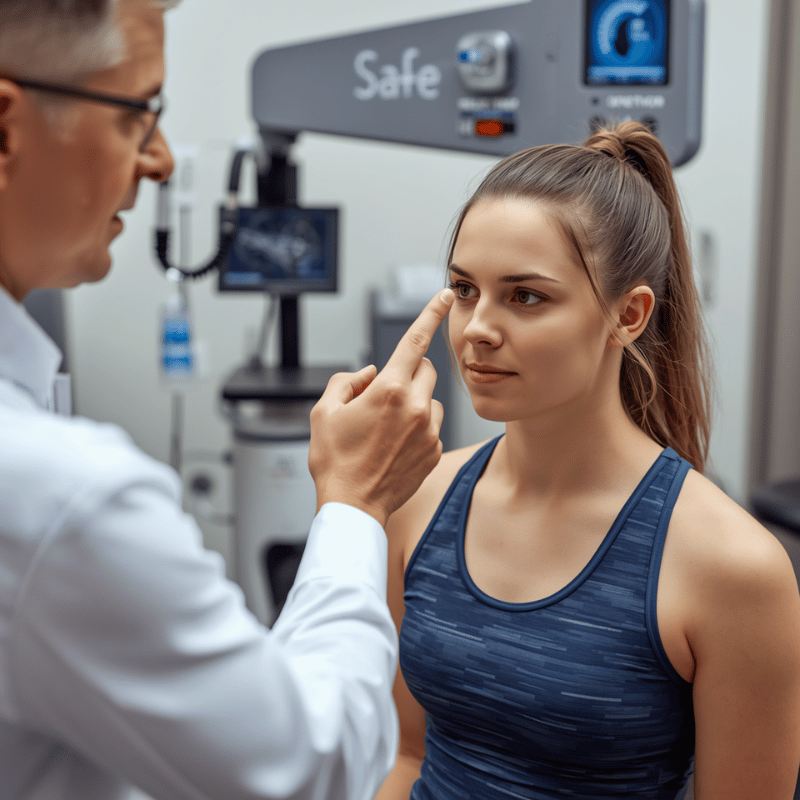
Cleveland Clinic’s concussion program has explicitly abandoned the old standard of sending a patient home to sit in a dark room for 72 hours. Their current protocol uses SCAT6 and SCOAT6 assessment tools for standardized, multimodal evaluation — with particular emphasis on vestibular-ocular testing and screening for dysautonomia, mood change, and learning difficulty, factors a basic symptom form misses entirely. Early, graded activity in the first 24 to 48 hours after injury is now outperforming isolation. Female athletes are noted to carry greater symptom severity on average, and higher initial symptom burden predicts longer recovery — both factors a one-size protocol will not catch.
The clinical direction is unambiguous: multimodal, systems-based assessment, started early, individualized to the athlete. A program still running symptom-checklist-plus-rest is not being conservative. It’s running a protocol its own field has moved past.
Why This Is a Protocol Question, Not Just a Medical One
Concussion litigation against schools, leagues, and athletic programs has been rising for over a decade, and the legal exposure consistently centers on the same question: did the program follow a reasonable, current standard of care in its return-to-play decision. A protocol that relies solely on a clean scan and a self-reported symptom form is harder to defend as “reasonable” and “current” the more clearly the field has published better tools. This isn’t a legal opinion — talk to your own counsel about your specific exposure — but the pattern in sports-liability reporting is consistent: protocol failure, not injury itself, is what turns a bad outcome into a claim.
What a Measurable Protocol Looks Like Today
Not every program has access to a research MRI machine. But the underlying principle — measure the regulatory system directly, don’t infer it from a subjective form — is deployable now. Our own Brain Health Assessment tests dopamine, serotonin, GABA, and acetylcholine directly, rather than relying on self-reported symptoms alone. In our outcomes data, 99 concussion patients have retaken that assessment after an initial baseline. Of the 57 who followed a personalized, system-level protocol before retesting, 89.5% showed a measurable drop in symptom score, averaging a 28.7% reduction. Of the 42 who retested without that intervention, only 54.8% improved, averaging a flat 4.3% change.
That’s not a claim that our assessment replaces diffusion MRI. It’s evidence that a measurement-first, systems-based approach outperforms a checklist-and-rest approach right now, with tools that don’t require a research hospital.
What to Do With This
If your program’s return-to-play protocol still rests on a clean scan and a symptom form, the field has moved and the data agrees: that’s an incomplete picture, and an increasingly hard one to defend as the current standard. Building measurement and correction into the protocol — not just clearance — is where this is headed. The programs and practitioners who move first aren’t waiting for a research MRI to become standard equipment.
For programs and practitioners ready to build this in: start with the Brain Health Assessment, or explore practitioner certification in Dynamic Brain Healing and NeuroFascial Release.
Sources
- A new concussion model for college athletes may help predict longer recovery times — NIBIB — https://www.nibib.nih.gov/news-events/newsroom/new-concussion-model-college-athletes-may-help-predict-longer-recovery-times
- Transforming Concussion Management with a Modern Approach — Cleveland Clinic — https://consultqd.clevelandclinic.org/transforming-concussion-management-with-a-modern-approach
- Concussion Protocol Failure Can Bring Negligence Claim — Athletic Business — https://www.athleticbusiness.com/operations/safety-security/article/15147806/concussion-protocol-failure-can-bring-negligence-claim
- The Impact of Litigation, Regulation, and Legislation on Sport Concussion Management — The Sport Journal — https://thesportjournal.org/article/the-impact-of-litigation-regulation-and-legislation-on-sport-concussion-management/
Brain Health Assessment improvement figures (89.5% / 54.8% / 28.7% / 4.3%) are Fascia Training Institute’s own internal outcomes data: 99 concussion patients who retook the Brain Health Assessment after an initial baseline (57 enrolled in a personalized protocol before retesting, 42 not enrolled), drawn from assessment records 2021–2023. Proprietary practice data, characterized by Simone Fortier from her own case records — not a peer-reviewed or externally published study. This article discusses legal liability trends in general terms and is not legal advice; consult qualified counsel for program-specific guidance.