Are You Starving the Brain You’re Trying to Heal?
Every concussion protocol prescribes rest. Almost none of them ask what the brain has to work with while it’s resting.
That’s not a wellness footnote. It’s a rate-limiting factor in recovery — and it’s measurable.
Neurotransmitters Are Built From What You Eat
Dopamine and norepinephrine synthesis draws on dietary tyrosine. Serotonin synthesis draws on dietary tryptophan. Acetylcholine synthesis draws on dietary choline. This isn’t a wellness claim — it’s precursor-dependent biochemistry, detailed in the National Academies’ own review of nutrient effects on neurotransmitter release: when plasma levels of these precursors run low, brain levels of the neurotransmitters they build follow. A brain trying to restore dopamine or serotonin balance after a head injury, without the raw material to synthesize either, is being asked to rebuild with an empty supply chain.
GABA runs on a different but equally nutrition-dependent pathway. It’s synthesized by converting glutamate through an enzyme called glutamate decarboxylase — and that enzyme is inactive unless it’s bound to pyridoxal-5-phosphate, the active form of vitamin B6. No B6 availability, no functional enzyme, no conversion. A brain low on GABA isn’t just “stressed” or “wired” — it may be missing the cofactor its own conversion pathway depends on.
One caution here, because this is where people get it backwards: a low GABA reading is not a reason to take a GABA supplement. Whether oral GABA meaningfully crosses the blood-brain barrier is genuinely unsettled science — the research is mixed, and a 2020 systematic review found no human data confirming it reaches the brain in any reliable way. In our own clinical experience, patients who self-supplement GABA directly typically see no change, and some report feeling worse. The brain is very likely already producing GABA on its own. The more useful question is whether the enzyme making it has what it needs to work — which is a B6 and cofactor question, not a “take more GABA” one.
We see this directly. The Brain Health Assessment tests dopamine, serotonin, GABA, and acetylcholine levels, and among our own concussion patients, every one has tested at moderate or major deficiency across this panel on intake. That’s not an occasional finding. It’s the pattern, every time, before nutrition is ever addressed.
Hydration Isn’t Optional Either
The brain’s glymphatic system clears metabolic waste from brain tissue and resets itself most actively during sleep. Researchers studying this system have proposed that dehydration reduces extracellular fluid volume in a way that directly impairs that clearance, along with the protein-folding processes underlying cognition — meaning a dehydrated brain doesn’t get to skip its overnight reset. It just runs it badly, night after night, while the patient wonders why eight hours of sleep isn’t translating into feeling rested.
Omega-3 fatty acids tell a similarly honest story, and it’s worth being straight about what the evidence actually supports rather than overselling it. The Department of Defense’s Traumatic Brain Injury Center of Excellence reviewed the omega-3 literature in 2025 and found real preclinical support — DHA and EPA support neuronal membrane structure, promote brain-derived neurotrophic factor production, and reduce neuroinflammation in animal studies — but concluded that human clinical evidence “has not been sufficiently replicated,” with some studies showing modest benefit (symptom resolution roughly four days faster) and others showing none. Official guidelines haven’t changed. That’s the honest state of the science, and it’s still directionally consistent with everything else here: a brain rebuilding itself needs raw material, and omega-3s are part of that raw material, even where the clinical proof isn’t airtight yet.
What Changes When You Correct It
Ninety-nine of our concussion patients have retaken the Brain Health Assessment after an initial baseline. Of the 57 who enrolled in a personalized protocol — including targeted brain nutrition — before retesting, 89.5% showed a measurable drop in symptom score, averaging a 28.7% reduction. Of the 42 who retested without that intervention, only 54.8% improved, and the average change was a flat 4.3%. Same assessment. Same starting severity. The variable that moved the number was whether the brain was actually fed and hydrated for the repair work it was already trying to do.
This is the mechanism the Brain Nutrition Program was built around: not general wellness advice, but targeted precursor and hydration support matched to what a patient’s own neurotransmitter panel shows is actually deficient. Paired with the Brain Health Assessment, it turns “eat better and drink more water” from a vague suggestion into a measured, individualized correction.
What Targeted Nutrition Actually Looks Like
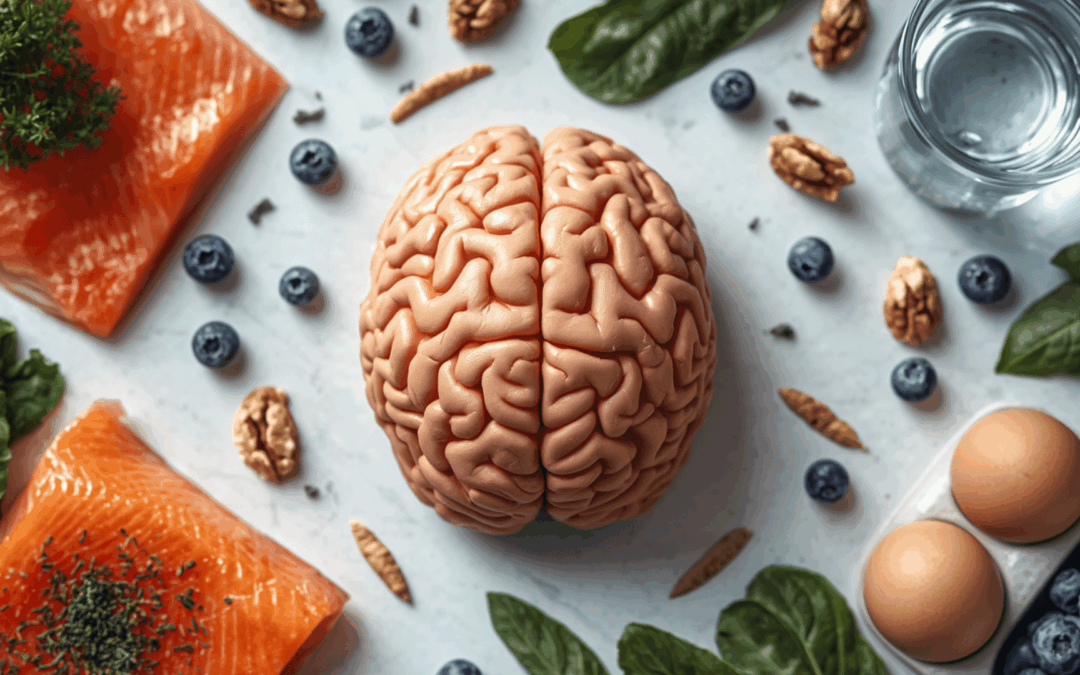
This isn’t “eat clean and drink more water.” It’s matching intake to whatever a patient’s own neurotransmitter panel shows is actually deficient. In practice, that means precursor-dense foods mapped to the specific pathway that’s underperforming: tyrosine from lean protein, eggs, and dairy for dopamine and norepinephrine; tryptophan from turkey, oats, and seeds for serotonin; choline from eggs and liver for acetylcholine; and B6-rich foods — poultry, fish, chickpeas — to keep the GABA conversion enzyme functional. None of that is exotic. It’s specific, and specificity is the part a generic “eat better” recommendation skips.
Hydration works the same way — volume alone isn’t the target. Electrolyte balance, particularly sodium and potassium, governs how efficiently fluid actually moves across cell membranes and through the glymphatic system’s clearance pathways. Water without electrolyte balance can move through a dehydrated system without ever correcting the extracellular fluid deficit that’s actually impairing clearance. And inflammation reduction — the fourth pillar most people think of as separate from nutrition — runs directly through diet as well: omega-3 intake, whole-food anti-inflammatory patterns, and avoiding the blood-sugar spikes that themselves drive neuroinflammatory signaling.
This is why the Brain Nutrition Program starts with the assessment, not a generic meal plan. A patient deficient in GABA and inflamed needs a different protocol than one deficient in dopamine and dehydrated. Treating them identically is the same error as treating every concussion identically — it ignores the system that’s actually in front of you.
Common Questions
How long does it take to correct a neurotransmitter deficiency through nutrition?
It varies by system and by how depleted the starting panel is, which is exactly why we reassess at 8 weeks rather than guessing. In our own data, patients on a personalized protocol showed measurable change by that point — a 28.7% average symptom score reduction — while patients without one averaged a flat 4.3%.
Can hydration alone resolve post-concussion brain fog?
Unlikely on its own. Hydration is a rate-limiting factor for glymphatic clearance, not a complete mechanism — a brain that’s also neurotransmitter-deficient or carrying unaddressed inflammation will still underperform even when fluid balance is corrected. That’s the case for treating the system, not one variable in isolation.
Is this the same as taking a multivitamin or a general supplement?
No. A generic supplement isn’t matched to which of the four neurotransmitter systems is actually deficient, or by how much. Targeted nutrition starts with measuring the deficiency, then matching intake to it — closer to a lab-guided protocol than a wellness-aisle purchase.
The Question Worth Asking
If recovery has stalled — for you, a patient, or an athlete under your care — the question isn’t only what got damaged. It’s whether the brain has been given what it needs to rebuild at all. For a large share of the people we test, the honest answer on intake is no.
Start with the Brain Health Assessment to see what your own neurotransmitter panel shows.
Sources
- Effects of Nutrients on Neurotransmitter Release (Wurtman) — Food Components to Enhance Performance, National Academies Press — https://www.ncbi.nlm.nih.gov/books/NBK209058/
- Dehydration and Cognition in Geriatrics: A Hydromolecular Hypothesis — Frontiers in Molecular Biosciences, 2016 — https://www.frontiersin.org/journals/molecular-biosciences/articles/10.3389/fmolb.2016.00018/full
- Information Paper on Omega-3 Supplements for Mild Traumatic Brain Injury — Traumatic Brain Injury Center of Excellence, March 2025 — https://health.mil/Reference-Center/Publications/2025/05/15/Information-Paper-on-Omega-3-Supplements-for-Mild-Traumatic-Brain-Injury
- Glutamate Decarboxylase (vitamin B6/pyridoxal-5-phosphate cofactor dependency for GABA synthesis) — Wikipedia, summarizing established enzymology — https://en.wikipedia.org/wiki/Glutamate_decarboxylase
- Effects of Oral Gamma-Aminobutyric Acid (GABA) Administration on Stress and Sleep in Humans: A Systematic Review (Hepsomali et al., 2020) — Frontiers in Neuroscience — https://www.frontiersin.org/journals/neuroscience/articles/10.3389/fnins.2020.00923/full
- GABA Supplements: Glorious, Gimmicky or Just Garbage? — McGill University Office for Science and Society — https://www.mcgill.ca/oss/article/health/gaba-supplements-glorious-gimmicky-or-just-garbage
Brain Health Assessment improvement figures (89.5% / 54.8% / 28.7% / 4.3%) are Fascia Training Institute’s own internal outcomes data: 99 concussion patients who retook the Brain Health Assessment after an initial baseline of moderate-to-major neurotransmitter deficiency (57 enrolled in a personalized protocol before retesting, 42 not enrolled), drawn from assessment records 2021–2023. Proprietary practice data, characterized by Simone Fortier from her own case records — not a peer-reviewed or externally published study. The observation that self-supplemented GABA typically produces no improvement, or a worse one, is likewise Simone Fortier’s own clinical observation, not a peer-reviewed finding; the published research cited above establishes only that oral GABA’s blood-brain-barrier penetration is unconfirmed in humans, not that supplementation worsens outcomes.