Neuroplasticity, Fascia, and the Brain–Body Connection: What Practitioners May Be Missing
Neuroplasticity Is Not Just About the Brain
The brain changes.
That is one of the most important discoveries to emerge from modern neuroscience.
Through neuroplasticity, the nervous system can modify its connections and function in response to learning, experience, movement, injury, environmental demands, and repeated sensory input.
This capacity is frequently discussed in relation to memory, cognitive training, exercise, sleep, and healthy aging.
But there is a larger clinical question:
Where is the information driving neuroplastic change coming from?
The answer is not just the brain.
The brain is continuously receiving information from the body.
Movement.
Pressure.
Tension.
Joint position.
Balance.
Pain.
Breathing.
Vision.
Vestibular input.
Interoception.
And sensory information arising from the fascial system.
For clinicians working with pain, concussion, movement dysfunction, rehabilitation, or human performance, that distinction matters.
Because neuroplasticity doesn’t simply mean that the brain can change.
It means the nervous system adapts to the information it repeatedly receives.
And not every adaptation is beneficial.
What Is Neuroplasticity?
Neuroplasticity describes the nervous system’s capacity to reorganize and modify its activity in response to internal and external stimuli.
Learning a new movement involves neuroplasticity.
Developing a new skill involves neuroplasticity.
Recovering function following neurological injury can involve neuroplasticity.
But so can compensation.
Guarding.
Movement avoidance.
Persistent pain patterns.
Repeated stress responses.
The important distinction is this:
Plasticity describes the capacity for change. It does not guarantee that the resulting change is optimal.
The nervous system can become more efficient at useful patterns.
It can also become highly efficient at patterns we would prefer it did not maintain.
This has significant implications for rehabilitation.
What Does Fascia Have to Do With Neuroplasticity?
Historically, fascia was often described primarily as connective tissue surrounding muscles and other structures.
That model is incomplete.
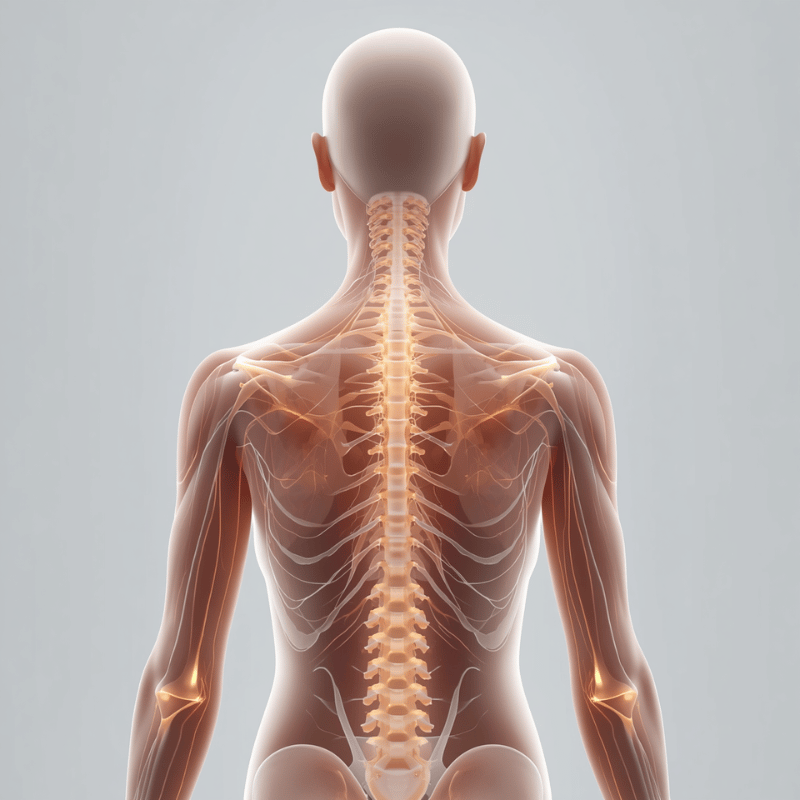
Fascia is an extensively innervated sensory tissue associated with proprioception, nociception, interoception, mechanical force transmission, and movement coordination.
That means fascia isn’t simply a passive structure clinicians manipulate.
It participates in the body’s sensory environment.
And that sensory environment matters to the nervous system.
Consider what happens when movement becomes restricted.
The person may begin moving differently.
Load distribution changes.
Muscular recruitment changes.
Joint mechanics may change.
Protective strategies develop.
Sensory information reaching the central nervous system changes.
If those patterns continue long enough, the nervous system has repeated opportunities to adapt to them.
This creates an important clinical proposition:
A persistent movement or pain problem may involve more than the tissue where symptoms are being experienced.
It may involve the way the nervous system has adapted to altered sensory input throughout the system.
Pain Is an Output, Not a Map to the Cause
A patient points to their shoulder.
The assumption is that the problem must be in the shoulder.
A patient reports headaches.
We focus on the head.
A patient has persistent neck pain.
Treatment stays at the neck.
But symptoms do not necessarily provide a precise anatomical map to the driver of dysfunction.
Pain is an output created by the nervous system from multiple streams of information.
That does not mean pain is imaginary.
It means pain is complex.
And this distinction should change assessment.
Instead of asking only:
“Where does it hurt?”
A more useful clinical investigation may include:
What changes the output?
What happens to range of motion when sensory input changes?
What happens to pain?
Balance?
Head pressure?
Movement quality?
Visual tolerance?
Concentration?
Fatigue?
If changing input somewhere else in the system produces an immediate measurable change, that response gives the practitioner information.
This is one of the principles behind the clinical reasoning taught at the Fascia Training Institute.
Neuroplasticity and Concussion: Why the Body Cannot Be Ignored
The brain–body relationship becomes particularly important when considering concussion and persistent post-concussion symptoms.
A concussion may be followed by symptoms including:
- Headache
- Dizziness
- Fatigue
- Brain fog
- Difficulty concentrating
- Memory changes
- Sleep disturbance
- Light or noise sensitivity
- Balance problems
- Neck pain
- Head pressure
- Exercise intolerance
These symptoms are clinically important.
But treating each symptom independently can fragment the problem.
A concussion does not occur in a neurological vacuum.
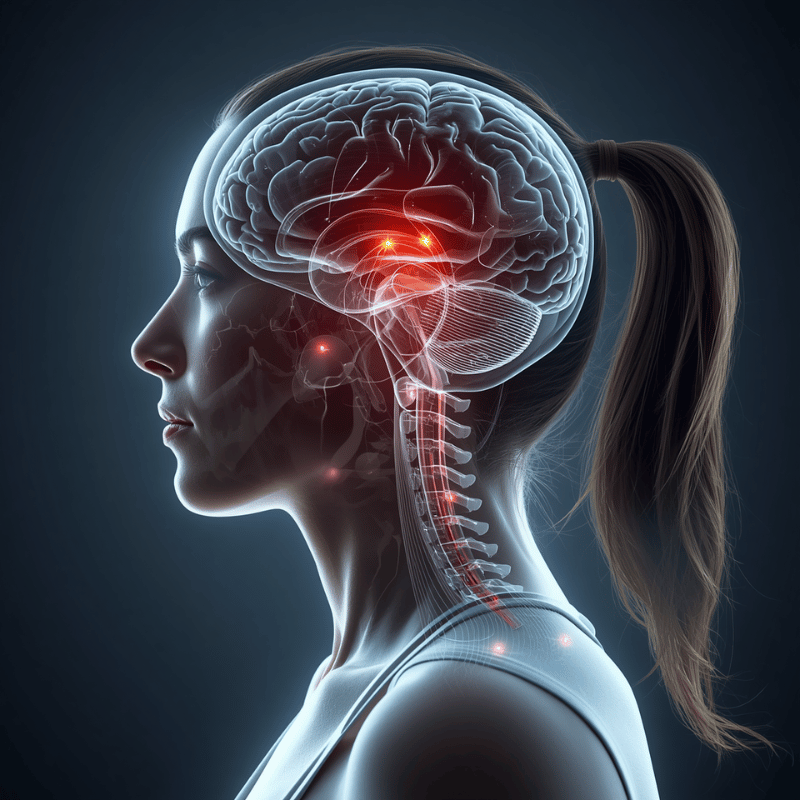
The brain interacts continuously with cervical sensory input, vision, vestibular processing, proprioception, autonomic regulation, breathing, movement, and the rest of the body.
That means clinicians need to consider not only what happened at the moment of injury, but also:
What information is the nervous system receiving now?
That question becomes particularly relevant when symptoms persist long after the original injury.
The Cervical Region Deserves More Attention After Concussion
Consider the mechanics of many head injuries.
If sufficient force moves the head rapidly enough to contribute to concussion, the cervical region may also have been subjected to significant mechanical forces.
Yet the brain and neck are frequently evaluated as though they were separate systems.
Clinically, that separation may be problematic.
Cervical structures provide substantial proprioceptive information used in spatial orientation, movement control, and sensorimotor integration.
When cervical input changes, the nervous system must interpret that altered information alongside vestibular and visual signals.
For a patient reporting dizziness, headache, disequilibrium, visual intolerance, or movement sensitivity, practitioners therefore need to think beyond a brain-only model.
The symptom may be experienced in the head while relevant inputs exist elsewhere in the system.
More Neuroplasticity Is Not Necessarily the Goal
One of the most common oversimplifications in neuroplasticity discussions is:
More stimulation = more improvement.
That is not how a complex nervous system should be approached.
A patient struggling with significant neurological load may already be processing enormous amounts of information.
Adding more exercises, more cognitive challenges, more stimulation, and more treatment is not automatically beneficial.
Sometimes the question is not:
“What else can we add?”
It is:
“What unnecessary load can we reduce, and what input should we change?”
This is particularly important in patients who become substantially worse after treatment or exercise.
The nervous system needs an appropriate stimulus.
Not simply a larger one.
Neuroplasticity Requires the Right Conditions
Several foundational behaviors can support brain health and neuroplasticity.
Regular physical activity is associated with numerous neurological and cardiovascular benefits.
Sleep plays an important role in memory consolidation and recovery.
Nutrition provides substrates necessary for normal neurological function.
Novel learning challenges the nervous system.
Social interaction engages complex cognitive networks.
Stress regulation can influence physiological load.
All of these matter.
But practitioners should consider an additional layer:
What is happening to the sensory environment of the nervous system?
A patient can eat well, sleep eight hours, exercise, meditate, and perform cognitive exercises while still operating within a persistent pattern of pain, restriction, compensation, or sensory mismatch.
That doesn’t negate those healthy behaviors.
It tells us the clinical investigation may need to go further.

The Practitioner Should Measure the Output
One of the principles we emphasize at Fascia Training Institute is simple:
Measure. Intervene. Re-measure.
Do not assume.
If an intervention changes neurological or mechanical input, determine whether the patient’s output changes.
Depending on the clinical objective, practitioners may examine:
Range of motion: Did movement increase?
Pain: Did symptom intensity or location change?
Balance: Did stability improve?
Movement quality: Did compensation decrease?
Head pressure or headache: Did the symptom change?
Visual tolerance: Did provocative movement become easier?
Cognitive clarity: Does the individual report a meaningful difference?
Function: Can the patient perform something they could not perform before?
This creates a fundamentally different treatment environment.
The practitioner is no longer applying techniques simply because a protocol says they should work.
They are testing the system.
Why This Matters for Fascia Treatment
There is a tendency within manual therapy to become technique-driven.
Find the tight structure.
Release it.
Stretch it.
Mobilize it.
Repeat.
But when fascia is considered part of a larger sensory system, the clinical objective changes.
The question becomes:
What response did the intervention create?
A large treatment response does not necessarily require aggressive treatment.
More pressure is not necessarily better.
More stretching is not necessarily better.
More treatment is not necessarily better.
The nervous system responds to input.
Clinical precision means identifying the amount and type of input capable of producing the desired response without unnecessarily increasing load.
Less can sometimes produce more.
From Tissue Treatment to Systems Thinking
This represents an important evolution in fascia education.
We should not abandon anatomy.
We should expand the model.
Instead of viewing the body as isolated structures requiring individual correction, practitioners can begin examining relationships among:
Brain ↔ fascia ↔ sensory input ↔ movement ↔ autonomic state ↔ behavior ↔ performance
The value of this model is not philosophical.
It is practical.
It changes how we assess.
It changes how we treat.
It changes what we measure.
And perhaps most importantly, it changes the questions we ask when a patient is not responding as expected.
Six Principles for Applying Neuroplasticity to Clinical Practice
1. Stop treating the symptom as the diagnosis.
Symptoms provide information, but they do not automatically identify the driver.
2. Evaluate sensory input.
Ask what information the nervous system is repeatedly receiving from movement, fascia, joints, vision, vestibular systems, and the environment.
3. Respect neurological load.
A nervous system under significant load may require precision rather than additional stimulation.
4. Change one meaningful variable.
If everything is changed simultaneously, it becomes difficult to determine what produced the response.
5. Re-measure.
Look for observable changes in function whenever possible.
6. Follow the response.
The patient’s nervous system provides information. Use it.
The Future of Fascia Training Is Neurological
The fascia field has changed dramatically.
The next step is not simply developing another manual technique.
It is understanding how the tissue we touch, the movement we prescribe, and the sensory information we alter interact with the nervous system.
That requires practitioners to move beyond a purely mechanical model.
Because the patient on the table is not a collection of individual tissues.
They are an adaptive biological system.
And that system is constantly learning.
Every intervention is information.
The question is whether we understand what information we are providing—and whether the nervous system is responding in the direction we intended.
That is where fascia, neuroscience, and neuroplasticity begin to converge.
And it is where the future of clinically intelligent fascia training becomes considerably more interesting.
Learn Brain–Fascia Integration at Fascia Training Institute
At the Fascia Training Institute, our practitioner education moves beyond memorizing techniques.
The objective is not simply to perform another technique.
It is to understand the system you are changing.
Explore practitioner training and upcoming courses at FasciaTrainingInstitute.com.