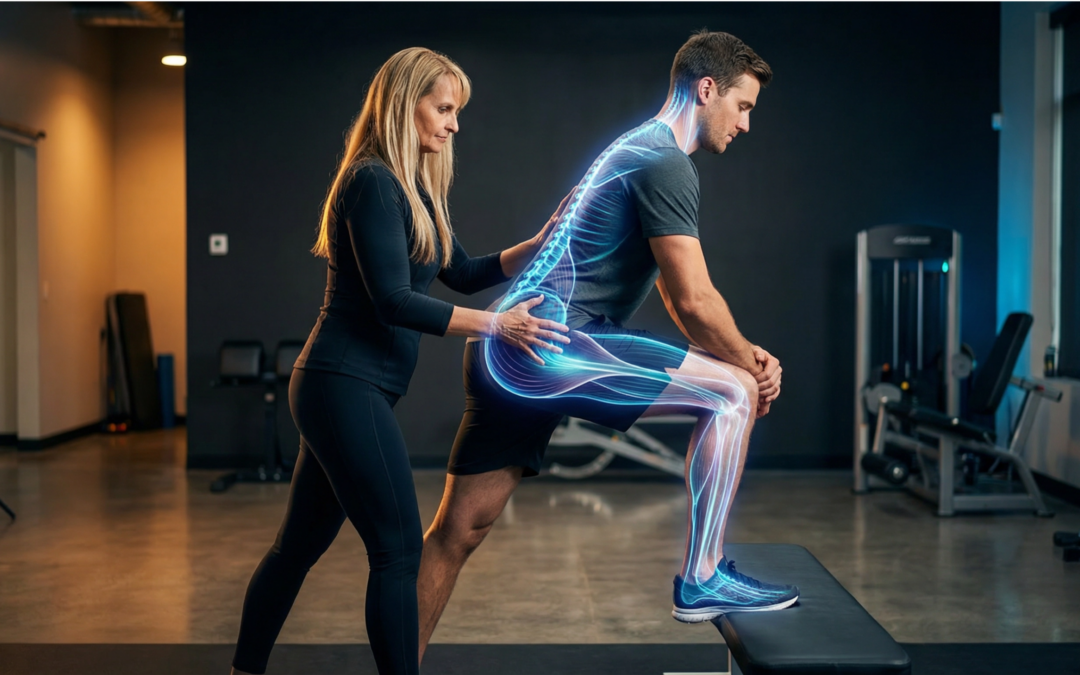
Fascia stretch therapy has grown significantly across Tampa and Florida – and for legitimate clinical reasons.
Practitioners are recognizing what research continues to confirm: the fascial system is central to movement, pain, and performance in a way the field had long underestimated.
But growth in a modality does not guarantee growth in clinical understanding.
What we are observing — across clinics, performance facilities, and training environments in Florida — is a pattern: practitioners delivering fascia release stretch therapy that produces immediate improvement in range of motion, followed by outcomes that plateau, regress, or require constant re-application to maintain.
That is not a technique failure. That is a systems failure.

What Fascial Stretch Therapy Addresses — And What It Does Not
Fascial stretch therapy, in its standard application, targets the structural properties of the fascial network. Tensional patterns. Restrictions in the myofascial meridians. Range of motion limitations that trace back to fascial adhesion, dehydration, or cross-linking.
This is legitimate and clinically relevant work.
What most fascia stretch therapy training does not address is the neurological system governing those fascial patterns in the first place.
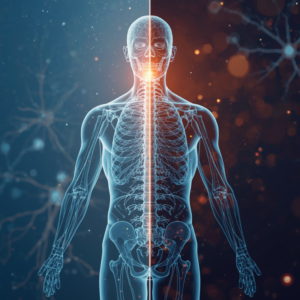
Fascia does not operate in isolation. It is in continuous dialogue with the central nervous system. Every fascial restriction is, at its core, a neurological output — a protective adaptation the brain has implemented based on its interpretation of threat, load, or prior injury.
Stretching the fascia without addressing the neural driver of that restriction is the clinical equivalent of treating a fever with ice packs. You are managing the output. You are not resolving the cause.
The Neurological Gap in Standard Stretch Protocols
This is not a criticism of practitioner skill. It is a description of how most fascia stretch therapy — including programs widely taught across Tampa and Florida — was designed.
The structural model says: find the restriction, address the restriction, restore the movement.
The neurological model says: find what the nervous system is protecting, create the conditions for the brain to release that protection, and allow the structure to reorganize.
One model works on the body. The other works with the nervous system. They are not the same process.
At the Fascia Training Institute, our fascia release stretch therapy framework is built on the neurological model. Every protocol begins with a systems assessment — not of the tissue, but of the neural state governing the tissue. What is the nervous system doing? What is it protecting? What input does it need to perceive safety and allow change?
This is what Dynamic Brain Healing and Quantum NeuroFascial Release bring to standard fascial stretch practice: a clinical framework grounded in neuroscience, validated across 30 years of application with elite athletes, post-surgical populations, and high-performance individuals.

Why This Distinction Matters for Tampa Practitioners
Tampa and the broader Florida market are saturated with fascia stretch therapy offerings. If you are a practitioner in this environment, the clinical distinction you carry is what determines your outcome profile — and ultimately, your reputation.
Clients who plateau are not failed clients. They are clients whose nervous systems were never included in the treatment protocol.
When the neural component is integrated into fascia release stretch therapy — when the stretch is sequenced to match the nervous system’s capacity to receive it, rather than forced against the brain’s protective response — outcomes change. Measurably. Consistently.
This is what we train. This is what the Florida intensive delivers.
What You Will Leave With
The Fascia Training Institute’s Tampa course is not an introduction to fascial anatomy. It is a practitioner-level recalibration of how you assess, intervene, and measure outcomes.
You will leave with a clinical framework for integrating neurological assessment into fascia release stretch therapy. You will understand why restrictions return — and how to address the system driving them. You will have measurable protocols you can apply the following week.
This is not theory. This is clinical application, taught by a practitioner who has built an international methodology on exactly these outcomes.