Advanced clinical education for qualified practitioners
NeuroFascial Release Dynamic Stretch™ Certification
Advanced Clinical Training at the Intersection of Fascia, Neurology, Movement and Performance
For chiropractors, physical therapists and physiotherapists, athletic therapists and trainers, manual therapists, strength coaches, and advanced massage therapists who need a more precise system for assessing restriction, restoring mobility, and changing the patterns that continue to limit function.
Pain is an output. Restriction changes the system producing it.
NeuroFascial Release Dynamic Stretch™ trains practitioners to identify priority restrictions, apply precise manual release, integrate movement, and document measurable change—not simply treat the location of a symptom.
Professional training • Maximum 20 participants • Continuing-education documentation available
The clinical question changes here
When the Symptom Keeps Returning, the Assessment Must Go Deeper
Many practitioners are highly skilled at treating pain, improving mobility, and restoring function. Yet some clients continue to return with the same restriction, compensation, or performance limitation.
The problem is not always the technique. It may be the level at which the system is being assessed.
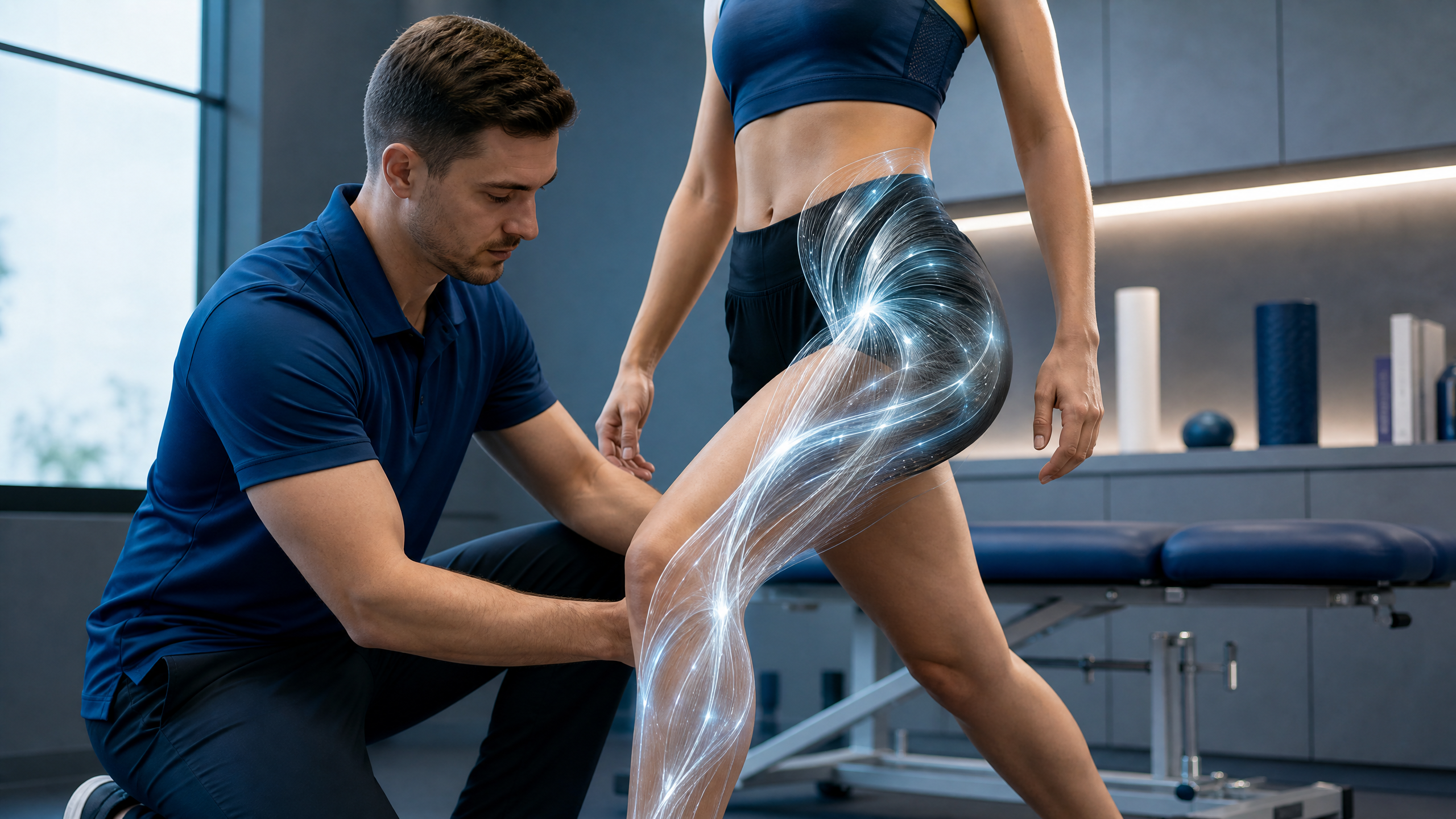
A shoulder restriction may not begin at the shoulder. A loss of hip mobility may be influenced by force transmission elsewhere. Protective neurological patterns can change tone, movement, and tissue response before pain appears at the site being treated.
Treating the loudest symptom is not the same as identifying the priority restriction.
This certification develops the clinical reasoning and palpation precision required to determine what the body is protecting, where load is being disrupted, and what should be addressed first.
The method
A Clinical System. Not a Collection of Techniques.
NeuroFascial Release Dynamic Stretch™ is a proprietary assessment and intervention system created to help qualified practitioners work with fascia as a sensory-rich, load-transmitting system that interacts with movement, posture, pain, and brain–body communication.
The method combines precise manual application with dynamic movement strategies. Practitioners learn to assess before intervening, prioritize before applying force, and retest so that change can be observed and documented.
01
Assessment-led
Assessment-led rather than protocol-first.
02
Neurologically informed
Neurologically informed rather than force-dependent.
03
Integrated across regions
Integrated across regions rather than isolated to the symptom site.
04
Measured
Measured through pre- and post-intervention findings.
05
Repeatable
Structured for repeatable clinical application.
Core principle
Precision Over Force
More pressure does not automatically create more change. In a guarded or overloaded system, aggressive input may create greater protection.
The FTI approach is based on a “less is better” clinical principle: use the level of input the system can interpret, sequence the intervention strategically, and verify the response.
The goal is not to force the tissue to change. It is to create the conditions in which the system can change.
Advanced palpation and fascial listening
Refine the information that guides the intervention.
Strategic sequencing
Address priority restrictions in the right clinical order.
Neurological safety and tissue response
Respect the system’s response to the input.
Manual release with dynamic movement
Integrate input and motion rather than treating them as separate events.
Objective retesting
Verify and document the response.
Who it is for
Built for Practitioners Responsible for Complex Human Performance
This neurofascial release certification is designed for professionals with a working knowledge of anatomy, physiology, movement, or manual practice.
01
Chiropractors
Qualified practitioners working within their professional scope.
02
Physical therapists and physiotherapists
Clinicians integrating assessment, movement, and tissue response.
03
Athletic therapists and athletic trainers
Professionals working with recovery and performance constraints.
04
Manual therapists
Practitioners who require more precise sequencing and retesting.
05
Strength and conditioning coaches
Performance professionals building better decision systems around movement.
06
Advanced massage therapists
Practitioners with the foundation to apply the method within scope.
07
Other qualified health and performance practitioners
Professionals accepted by FTI after consideration of training and scope.
Scope of practice: Scope of practice varies by profession and jurisdiction. Every participant is responsible for applying course material within their professional designation, regulatory requirements, and permitted scope.
What practitioners develop
Move Beyond “Where Does It Hurt?”
The certification develops a more complete way to assess and respond to restrictions affecting mobility, recovery, and performance.
- Recognize relationships between the symptom site and the wider fascial system.
- Use palpation and movement findings to identify priority restriction patterns.
- Differentiate superficial, deep, visceral, and neural fascial influences within the course framework.
- Apply upper- and lower-body manual release protocols with precision.
- Integrate dynamic stretch and movement based on the individual pattern.
- Sequence interventions across cranial, cervical, thoracic, pelvic, and peripheral regions when appropriate.
- Retest range of motion, symptoms, movement, and functional response.
- Document case outcomes using a standardized methodology.
Clinical application
Designed for the Cases That Do Not Fit a Single-Region Model
Practitioners may integrate the system into work involving:
- Persistent neck, shoulder, back, hip, leg, and foot restrictions.
- Postural compensation and asymmetrical movement patterns.
- Mobility limitations that recur after conventional intervention.
- Cranial, cervical, jaw, and whole-body tension relationships.
- Recovery and performance limitations associated with restricted force transmission.
- Clients and athletes who require an assessment-led, system-level approach.
Clinical education notice: Course education does not replace diagnosis, emergency care, regulated clinical judgment, or referral to an appropriate healthcare professional.

Why it is different
The Difference Is Clinical Reasoning
The distinction is not a more elaborate sequence. It is a more disciplined way to assess, prioritize, intervene, and verify.
Common technique-based training
Begins with the painful region
Often starts at the loudest symptom.
NeuroFascial Release Dynamic Stretch™
Begins with assessment and prioritization
Identifies the restriction pattern before selecting input.
Common technique-based training
Applies the same sequence broadly
Defaults to protocol before individual pattern.
NeuroFascial Release Dynamic Stretch™
Responds to the individual restriction pattern
Uses the findings to guide the sequence.
Common technique-based training
Uses pressure as the primary variable
Assumes more input will create more change.
NeuroFascial Release Dynamic Stretch™
Uses precision, timing, direction, and neurological response
Works with the system’s response rather than against it.
Common technique-based training
Measures course completion by attendance
Attendance is treated as the outcome.
NeuroFascial Release Dynamic Stretch™
Requires practical competency and case application
Competence must be demonstrated within the taught framework.
Common technique-based training
Focuses on isolated tissue change
Separates manual input from movement and retesting.
NeuroFascial Release Dynamic Stretch™
Integrates manual input, movement, and system-wide retesting
Uses feedback to direct the next clinical decision.
Certification pathway
Training Is the Beginning. Competency Is the Standard.
NeuroFascial Release Dynamic Stretch™ is taught through a structured pathway that moves practitioners from foundational assessment and application into deeper integration and clinical reasoning.
01
Foundation Training
Build the assessment framework, palpation precision, upper- and lower-body application, dynamic movement integration, safety principles, and outcome-testing process.
02
Practical Evaluation
Demonstrate safe, precise application and the ability to assess, select, apply, and retest within the taught framework.
03
Case-Study Application
Complete four required case studies—two upper-body and two lower-body—to demonstrate real-world application and outcome documentation.
04
Credentialing
The credential or continuing-education recognition available depends on professional designation, association requirements, jurisdiction, and successful completion of applicable course requirements.
Evidence
Outcomes Must Be Observed. Then Documented.
FTI education emphasizes measurable change. Practitioners are trained to establish a baseline, apply the appropriate intervention, retest, and document what changed.
PLACEHOLDER — Approved White Paper
Insert before publication: approved title, concise study description, participant count, methodology, verified key range-of-motion or symptom findings, limitations statement, and link to the complete paper or research-library page.
Recommended treatment: one restrained headline, three verified statistics, one methodology sentence, and one clear statement that findings are preliminary and do not guarantee individual outcomes.
PLACEHOLDER — Before-and-After ROM Feature
Insert before publication: approved pre/post range-of-motion visuals with measurement conditions, body region, elapsed time, practitioner context, and an outcomes disclaimer.
Do not use unlabelled transformation imagery. Do not add outcomes without the verified source and context.
Social proof
What Changes When Practitioners See the System Differently
Specificity is the standard. These spaces are reserved for documented practitioner experience—not generic praise.
PLACEHOLDER — Clinical reasoning
Insert an approved practitioner account describing a specific assessment or clinical-reasoning breakthrough.
Required: permitted full name, credential, location, approved photograph, and precise proof statement.
PLACEHOLDER — Measurable outcome
Insert an approved account of a measurable client or athlete outcome, with the appropriate context and disclaimer.
Required: permitted full name, credential, location, approved photograph, and source-supported detail.
PLACEHOLDER — Practice integration
Insert an approved practitioner account of how the framework was integrated into an existing professional practice.
Required: permitted full name, credential, location, approved photograph, and a concrete integration example.
Founder authority
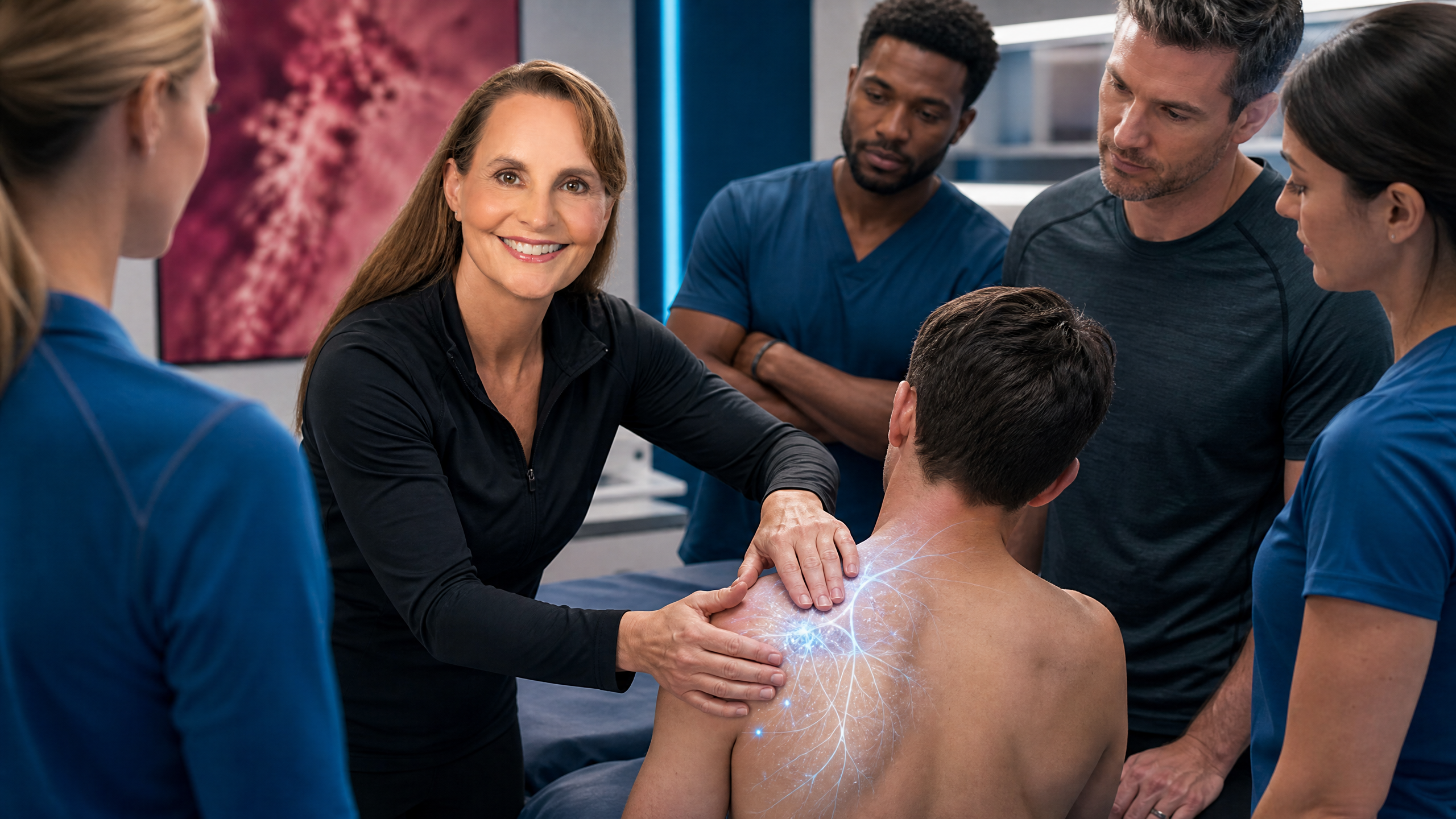
Developed and Taught by Simone Fortier
Simone Fortier is the founder of the Fascia Training Institute and the creator of NeuroFascial Release Dynamic Stretch™. For more than 30 years, her work has focused on fascia, brain–body integration, mobility, recovery, and human performance.
Her methods have been applied in work with professional and Olympic athletes, practitioners, and people with persistent or complex presentations. The certification translates decades of clinical observation, assessment refinement, and hands-on application into a system practitioners can learn, test, and document.
This is not theory separated from practice. It is a clinical system built through practice, refined through outcomes, and taught with standards.
PLACEHOLDER — Organization / Professional Logo Band
Include only logos with documented permission and clarify the nature of the relationship. Do not imply endorsement.
The learning environment
Small Enough for Precision
Training is limited to a maximum of 20 participants so practitioners can receive direct instruction, observe application, practise palpation and sequencing, and receive meaningful feedback.
- Founder-led instruction.
- Hands-on learning and supervised practice.
- Practical testing rather than attendance alone.
- Structured case-study requirements.
- Professional continuing-education documentation available.
Eligibility notice: Participants should confirm continuing-education eligibility and credit acceptance directly with their professional association or regulatory body before registering.
For experienced practitioners
You Do Not Need Another Technique. You Need a Better Decision System.
If you already have manual therapy, rehabilitation, or performance training skills, this certification is designed to organize and deepen how you decide what to address, when to address it, and how to verify whether the intervention changed the system.
The objective is not to replace your professional foundation. It is to add a precise neurofascial framework that can strengthen assessment, treatment sequencing, movement integration, and outcome documentation within your permitted scope.
FAQ
Professional Education. Clear Standards.
Is this course intended for the general public?
No. This is professional education for qualified health, manual therapy, movement, and performance practitioners. Admission may be reviewed based on training and scope.
Do I receive certification simply by attending?
No. Certification requirements include full participation, practical competency, applicable testing, and completion of four case studies: two upper-body and two lower-body.
What credential will I receive?
The credential available depends on your professional designation, association requirements, jurisdiction, and completion of the applicable FTI requirements. FTI will provide the relevant course documentation.
Are continuing-education credits available?
Continuing-education documentation is available. Approval and the number of accepted credits vary by profession, association, and jurisdiction. Confirm eligibility with your association before registering.
Can I use the methods with clients immediately?
Application must remain within your existing professional scope, competence, insurance requirements, and local regulations. Some designations may require completion of additional certification components.
How large are the classes?
Enrollment is limited to a maximum of 20 participants to protect hands-on learning quality and instructor feedback.
Are payment plans available?
No payment plan is offered for this training.
What is the refund and transfer policy?
Registration fees are non-refundable. Subject to the full terms and conditions, an eligible registration may be transferred to another scheduled FTI course.
Where can I see dates, cities, and registration details?
Select View Upcoming Trainings to see current course locations, dates, availability, and event-specific registration information.
The Standard Is Not More Force. It Is Better Information.
If you are ready to assess beyond the symptom site, work with greater precision, and document changes in mobility, symptoms, and performance, NeuroFascial Release Dynamic Stretch™ provides the system and certification pathway.
See the restriction. Change the system. Measure the outcome.